


We spent last weekend in the Dominican Republic teaching Baseball as a Special Strength.
Friday was a private session with the Pittsburgh Pirates performance staff at their academy. Saturday and Sunday were an open seminar at Elite Athlete Center. Three days, one reframe.
The Reframe: Baseball as a Special Strength
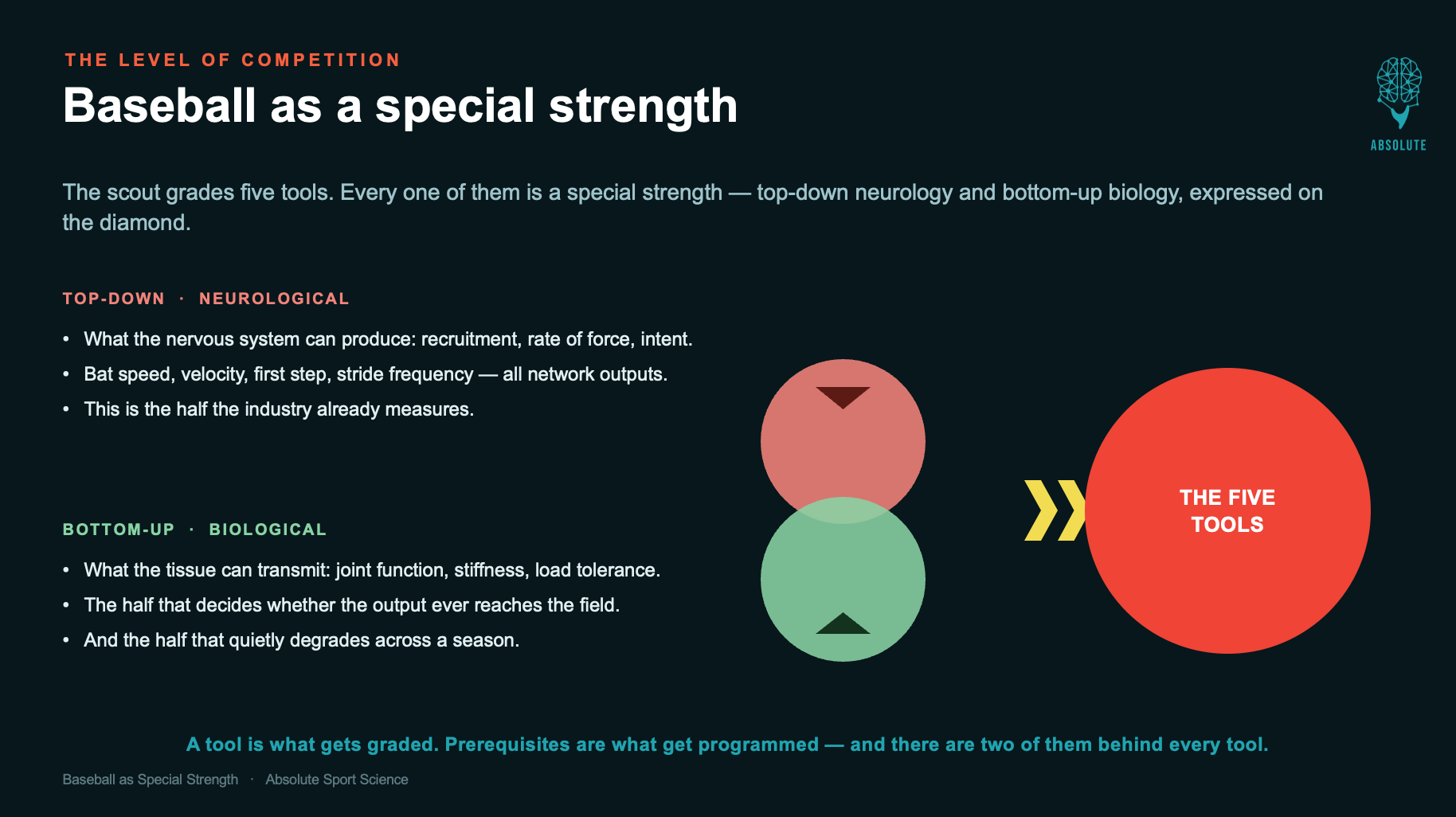
Baseball is understood as a skill, and that understanding is useful—it is what makes skill coaching possible. But the skill lens returns coachable findings: self-organizing, things the athlete solves, things a skill coach can practice, cue and rep. It does not return treatable and trainable findings. And you cannot program a coachable finding.
So if you want to know how to program treatment and training work for specific to the sport of baseball and individual to the athlete, you have to observe and understand baseball as a special strength—strength expressed under the exact neurological and biological conditions the sport imposes. Every throw, every hit, every time a ball gets fielded qualifies as a special strength. The scout grades five tools—hitting for contact, hitting for power, fielding, running, and throwing; every one of them has top-down neurological components and a bottom-up biological components.
A tool is what gets graded and coached. The neurological and biological prerequisites of those tools are what get programmed.
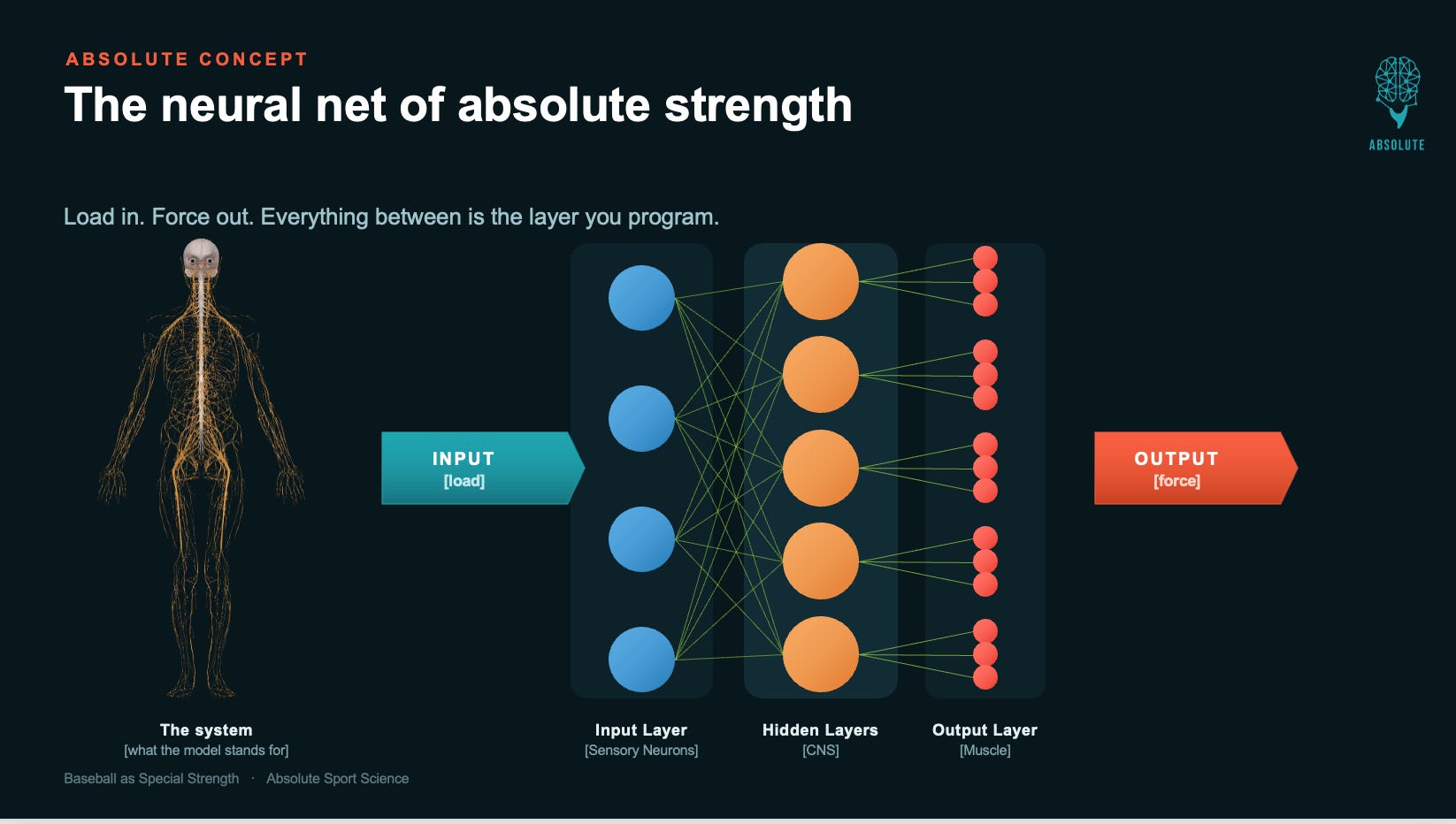
Friday. With the Pirates staff we built the model from the ground up—Absolute’s inside-out mental model of special strength, the neural network of absolute strength, Point A → Point B, the Neurological–Biological Asymmetry, and the conjugate strategy that answers it.
Saturday—bottom-up biology. This was Biological Point B. Joint function and reactive strength. Joint function is macro range externally and micro motion internally, governed by capsular space—and space is dynamic. It can be acquired and it can be lost. Reactive strength is emergent: the CNS outputs, the connective tissue reacts. The damping effect sits at the center of it, tissue stiff enough to self organize to transmit force rapidly and compliant enough to dissipate what would otherwise damage tissue.
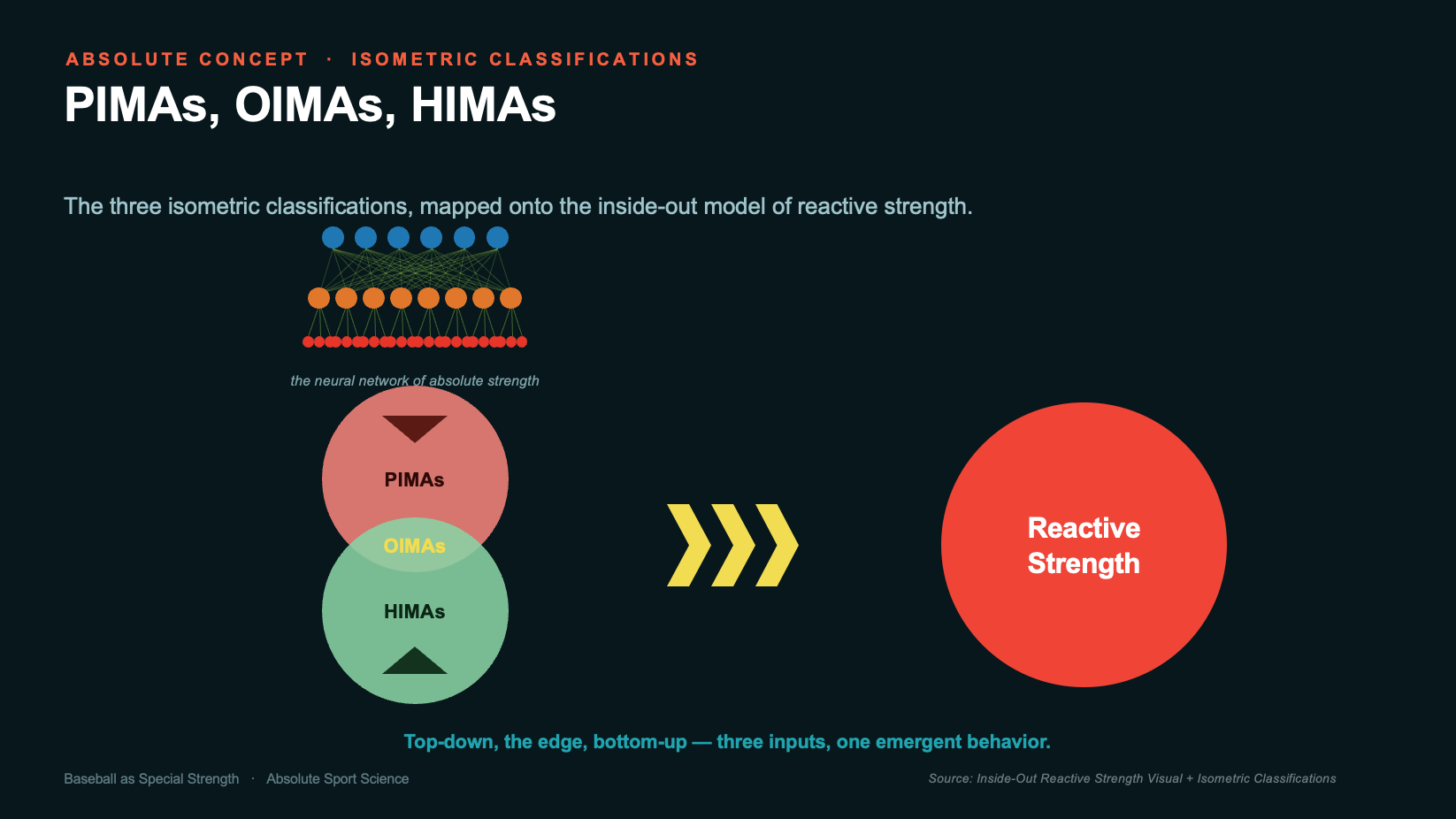
Then main focus of the day was centered on framing connective tissue injuries are reactive strength injuries. Calf, hamstring, forearm, UCL, Achilles—different tissues, one mechanism, a bottom-up capacity that never scaled with top-down output. We worked through published case studies of Konnor Griffen, the Phillies, Francis Lindor and then spent the afternoon on the Internal Isometric Continuum and the three classifications—HIMAs, PIMAs and OIMAs—including the oscillatory work we have spent the last year refining.
Sunday—top-down neurology. This was Neurological Point B. Absolute strength and speed strength, and the neural network of absolute strength that produces both. We programmed and did a practical for how to take a training max. Discussed the distinction most people never make is intensity: at a stimulating intensity you are adding nodes to the network, at a retaining intensity you are turning the existing ones on.
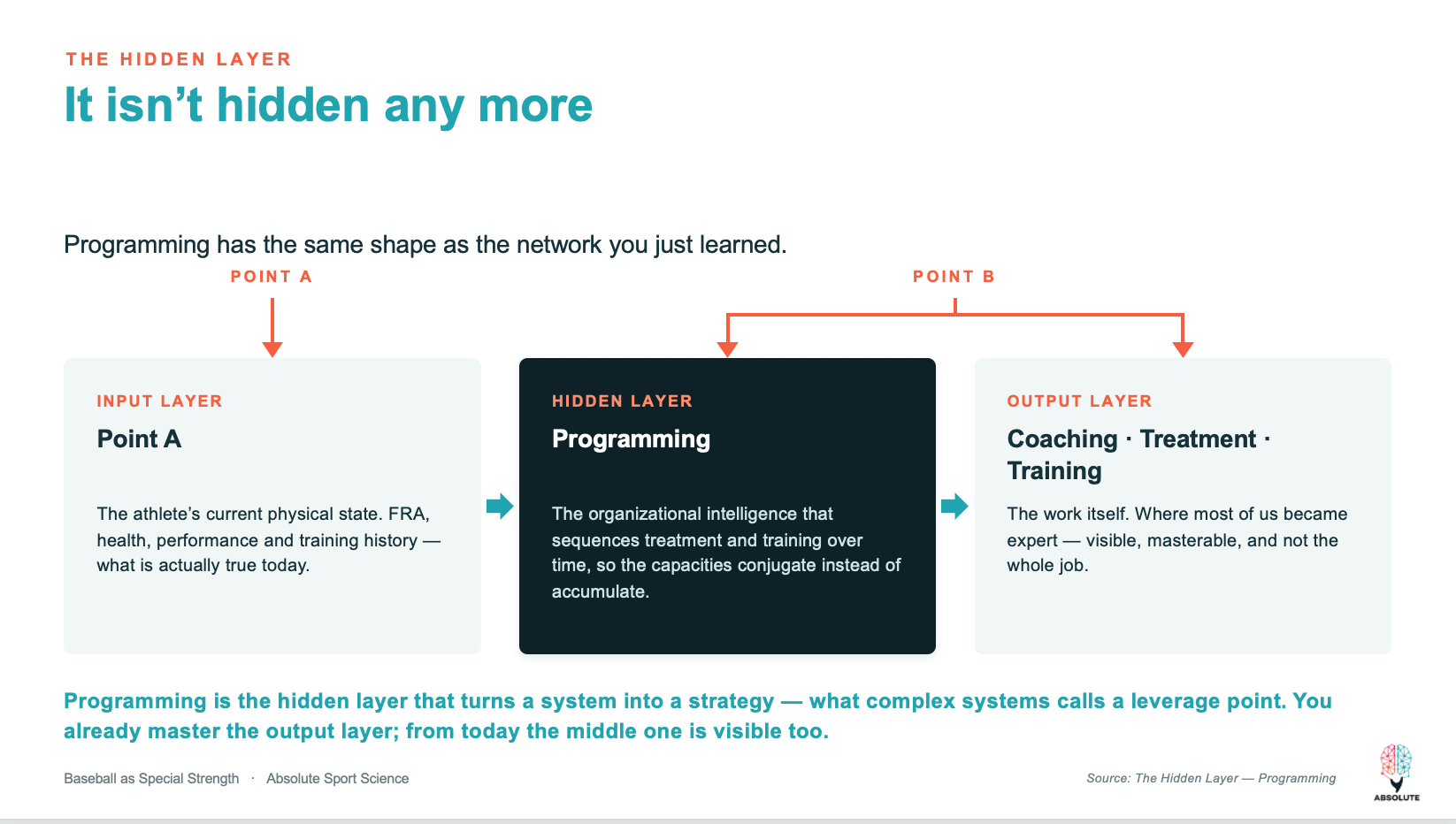
Everything we taught is published here. If you want the mechanics rather than the lens, The Art & Science of Programming is the module that lives in the hidden layer.
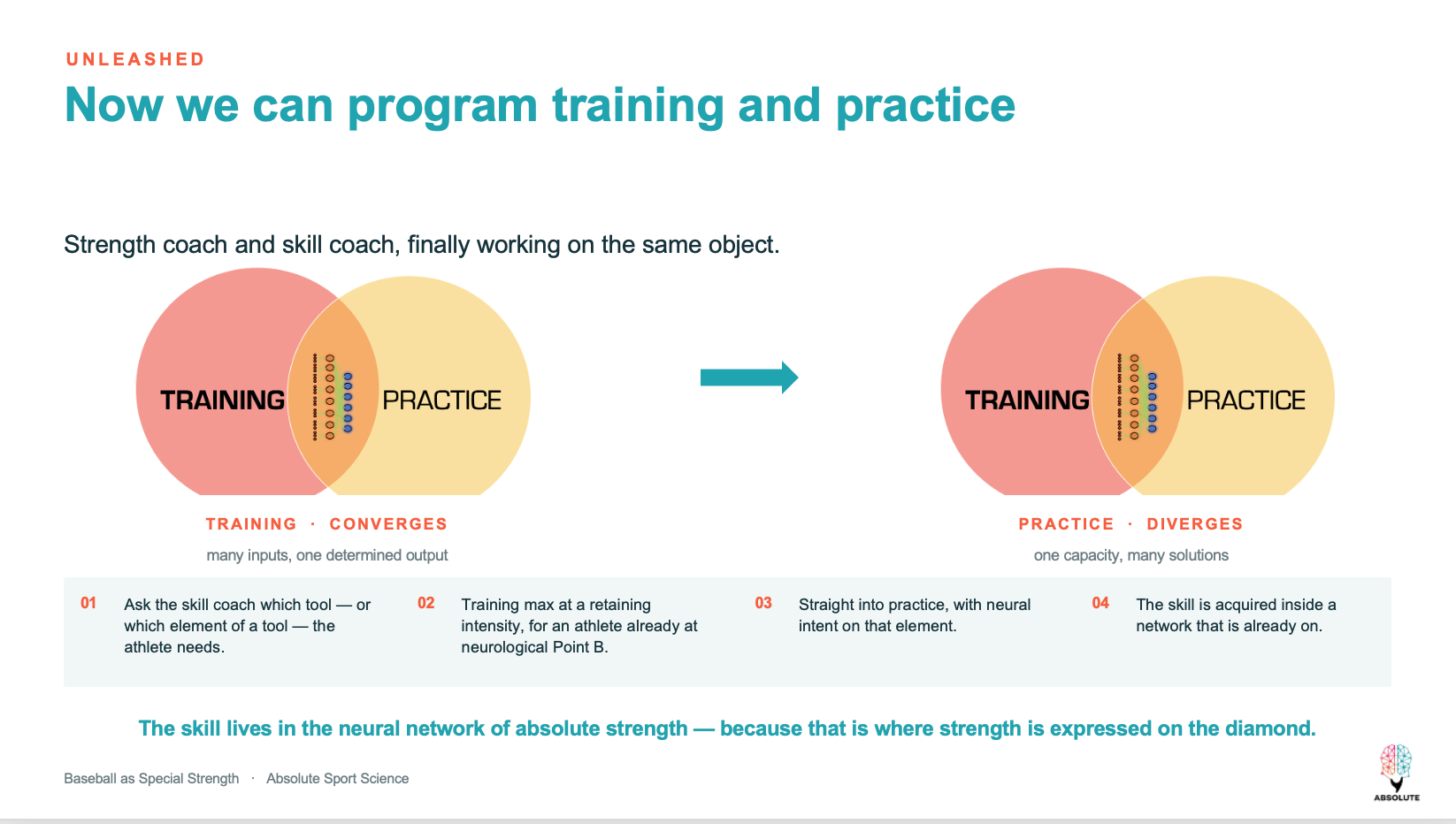
Which sets up the most practical idea of the weekend—conjugating training and practice for the baseball athlete. Turn the nodes of the network on, then go use it—a training max at a retaining intensity, then straight into the cage with neural intent on the tool the Level of Competition says the athlete needs. Training converges; practice diverges. Practice can only draw on what training has made available. Use programming to get the baseball athlete to neurological Point B and practice now becomes the special strength of baseball emerging.
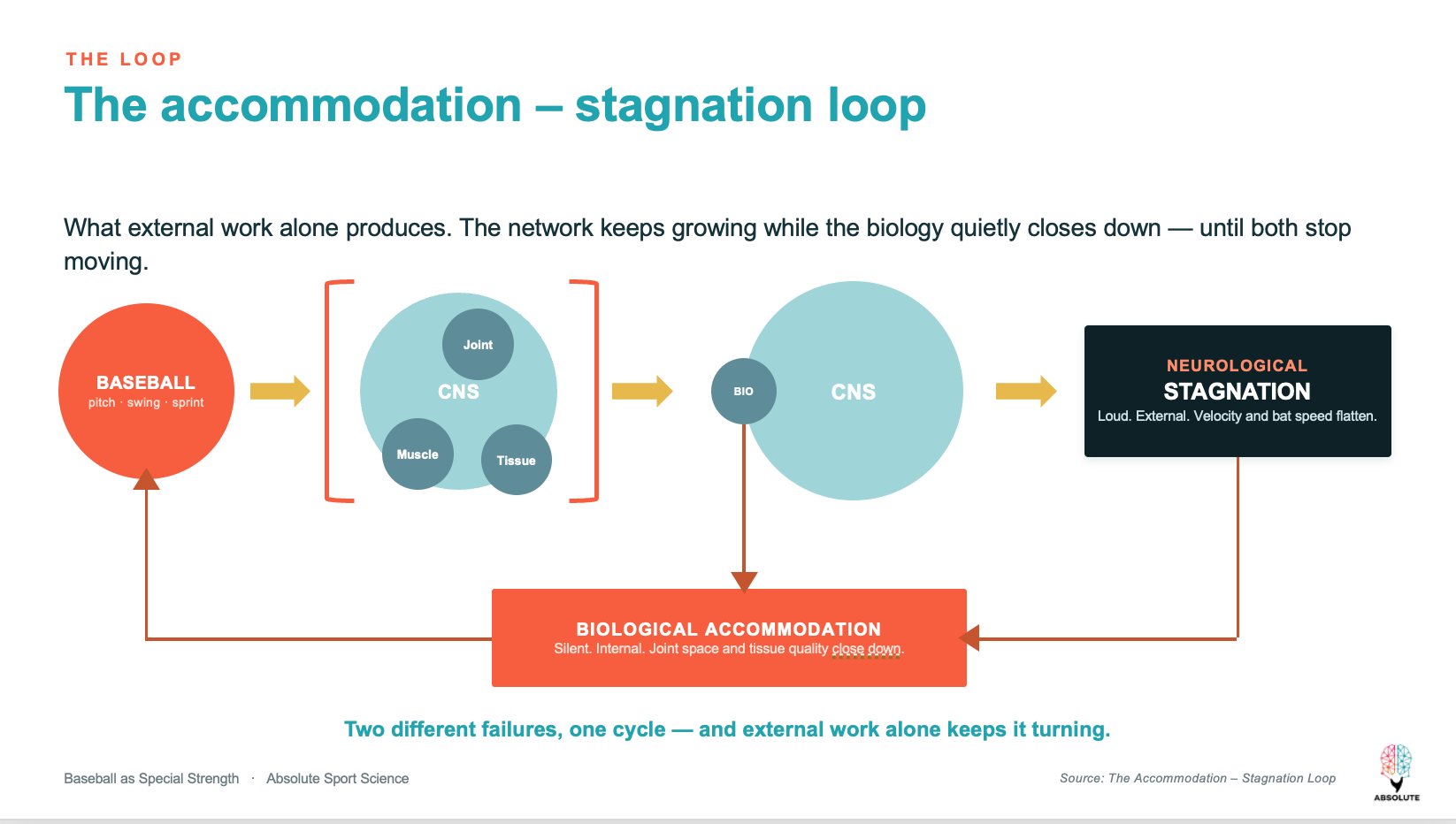
We closed on neurological stagnation—the accommodation–stagnation loop, and programming as strategy that gets the most out of treatment and training. The absolute conjugate strategy for baseball is to acquire the neurological and biological prerequisites of the five tools—getting the athlete from Point A to Point B.
We are already scheduling the next Baseball as a Special Strength seminar for this offseason. Make sure to subscribe and you will hear about it first.
Thank you to the Pittsburgh Pirates performance staff—specifically Orlando Crance, Ariel Mercedes, Jack Cecil and to Elite Athlete Center for hosting, and to everyone who traveled and asked hard questions for two days.
Want to run this inside your program?
Friday we did exactly this with the Pittsburgh Pirates’ performance staff at their academy — the full model, built from the ground up, in their facility with their people.
We run in-house seminars for professional and collegiate programs. Tell us about your program and we’ll set up a call.


