


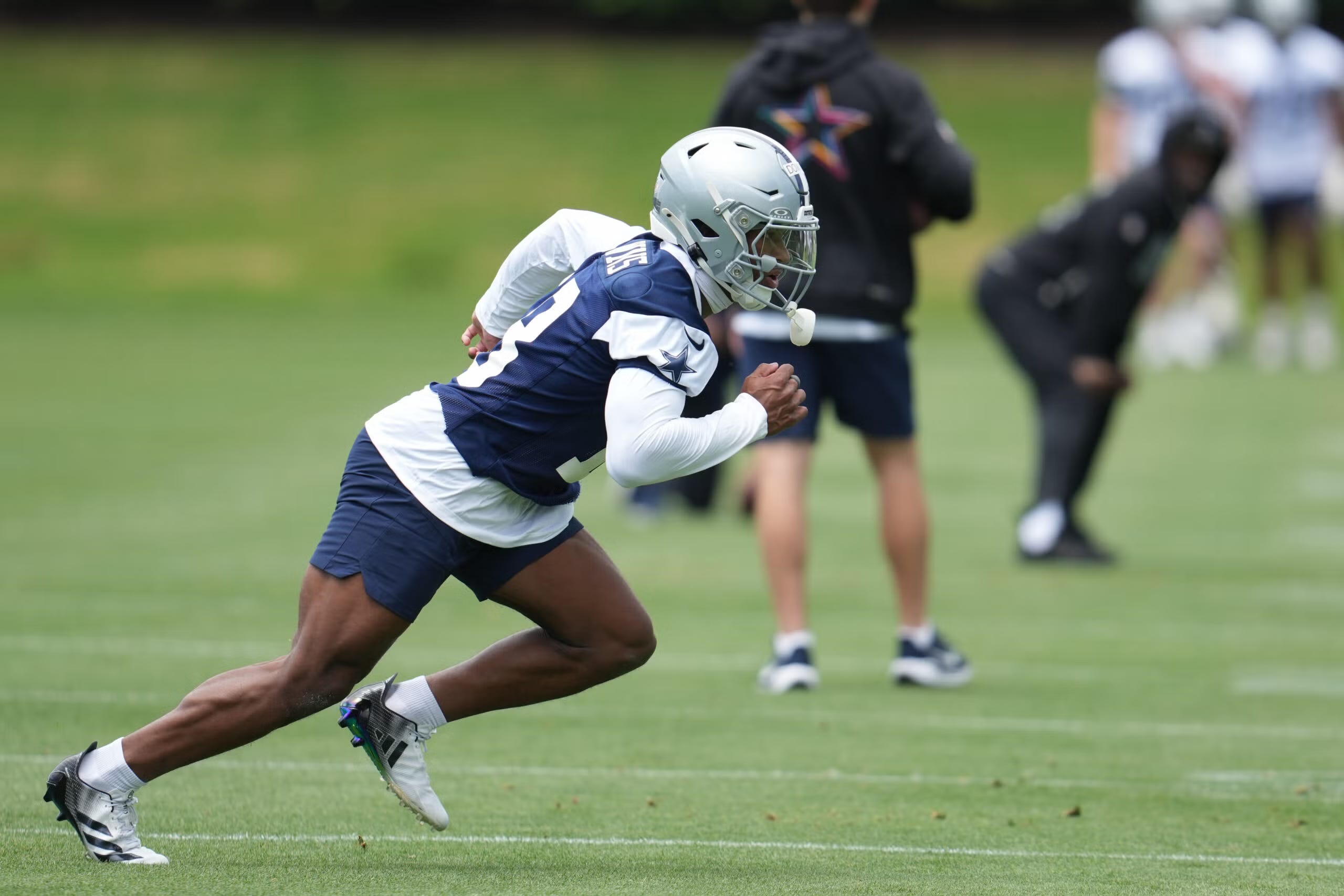
A note before we start: the reporting on Caleb Downs’ knee is unconfirmed. We have no relationship with Downs or his medical team. We’re using the public reporting as a hypothetical to illustrate a finding we see constantly in our own practice—because the case, if true, is a textbook example of something most performance staffs never assess for.
Here’s the report, via USA Today: a partially torn meniscus, and a potentially degenerative ACL. No confirmation, just a denial from Downs. A lot of questions that swirled around him and his knee joint ahead of the 2026 NFL draft—and a slide out of the top 10, despite being the consensus best defender in the class, that ended with Dallas trading up to take him at 11.
The meniscus tear, if real, isn’t confusing. Downs is dynamic, explosive, violent in how he closes space. Any clinician in high performance hears “meniscus” on a player like that and nods. Makes sense.
The degenerative ACL (if true) is the part that doesn’t make sense. Until it does. Once you see special strength from the inside-out—you just a cannot unsee it.
If you want to program for reactive strength you need a mental model not a definition.
Most college football programs treat reactive strength as a number—RSI on a force plate, if they even have any feedback loop at all to monitor this special strength. RSI stands for Reactive Strength Index, and it’s a measurement, not a model.1 RSI isn’t wrong—it’s incomplete. It is a measurement and not a model.
When we take that measurement and funnel it through our inside out mental model of reactive strength, it obvious that it primarily captures the behavior of the top-down element: how well the nervous system organizes and expresses force in that moment. That is great, but understand—it entirely misses the nuances of bottom-up element—programable connective tissue bits of information.
Put simply, just like an MRI does not tell a manual practitioner how to program treatment in real time, information from the RSI does not enable the programming strategist the ability to know how to program reactive strength in real time. This is why as programming strategist that work in the clinical space, do we ever ask before treating and athlete with a reactive strength deficit do we ask: what is the RSI?
Neurological Point B Arrives First, Maybe Biological Point B Catches Up
Our programming model is Point A to Point B: the distance between where an athlete operates now and the optimal physical state they need to reach to perform at the Level of Competition, repeatedly—without injury.
Point B has two versions, and they rarely arrive together.
Neurological Point B is the neural network’s capacity to organize a magnitude of and express that output at speed. For us, it’s a real time conjugation of absolute strength with speed strength. Neurological Point B is trainable, and it adapts in real time fast. If you know what to look for you see the neutral network learn in real time.
Biological Point B is the biological capacity of the joints + connective tissue transmitting the energy the neural network is outputting into force—at the highest attainable speeds. That’s reactive strength, in the narrow sense.
In the college football athlete, the neurology can get to Point B years ahead of what the biology can optimally express at the Level of Competition. Don’t take our word for it—see Malik Naber’s having a reactive strength deficit in high school, that is still present to this day.
Biological Point B is the bottom half of our inside-out special strength mental model almost no college football program in the country, outside the couple we work with directly, ever assesses, regardless if the athlete is hurt or healthy and is the blind spot this substack is about.
The Neurological-Biological Asymmetry
We’ve never worked with Downs—but we have and currently work directly with this athlete population, extensively. Our experience allows us to not need to have to work directly with these athletes to recognize the pattern of bottom up reactive strength deficits—because we see it in every college football athlete who comes through our practice. These athletes are on some of the best rosters in the country and getting paid millions: operating at Neurological Point B, nowhere near Biological Point B, and a Point A performance history built entirely on that gap that has never been filled.
Programming the treatment and training strategy of these specific athletes is how the concept of the neurological-biological asymmetry emerged from Absolute. Not theory, this is our direct work with this specific athlete type. As programming strategist responsible for their physical development, safety and well-being, we have to immediately label them as possessing this asymmetry and having to take the appropriate programming action. It’s the same asymmetry we laid out with Malik Nabers—a nervous system years ahead of the tissue underneath it, compensating in ways that look like talent until the exact moment they don’t.
College football is the perfect ecosystem for developing neurology and never assessing the biology.
Every program has force plates. Every program has GPS tracking. Most have 1080s. What almost none have is a staff member whose job is monitoring the bottom-up, tissue-level side of reactive strength—the biology that enables the output the wearables are celebrating.
College football will show you all the neurological output you want. These programs have the resources—they pay players millions, they can pay to acquire—literally buy, the best neurology in the country. What they can’t show you is the biology. Nobody’s monitoring the bottom-up side of reactive strength, because the top-down side is what the football coaches want and that is who the performance staffs work for.
In investing terms, these programs are over-leveraged with zero hedge. The neurological system is the leverage—it’s producing returns (speed, explosiveness, violence) far beyond what the underlying asset (the joint/tissue) has been shown to support without degradation. Nobody’s hedging the position, because nobody’s tracking the asset. It’s remarkable to watch play out in real time across a sport this well-resourced.
Physicist Richard Feynman put it best: “The first principle is that you must not fool yourself—and you are the easiest person to fool.”
Sport scientists monitoring reactive strength with zero biological data aren’t lying. They’re just fooling themselves—mistaking a complete-looking dashboard for a complete picture. That gap is exactly how you get athletes like Nabers and Downs scaling up to the next Level of Competition into the NFL already carrying a reactive strength deficit nobody measured—and the gap is likely widening.
This reactive strength deficit is something we identified first at Absolute, and one we’ll be covering all college football season. That's the case we made in The Conjugate Edge #10: OIMAs (the hedge)—our argument for why OIMAs should be the number one isometric programmed for this specific athlete demographic.
Everything above is the pattern. Everything below is the mechanism: how a nervous system actually shields a joint, why we think that’s exactly what happened with Downs, and a live example from a major program’s ACL protocol showing how invisible this is—even to one of the best staffs in all of college football. For paid subscribers.
