


Welcome to Installment #07 of The Conjugate Edge. Each month, we publish one essay designed to help programmers in strength and clinical settings step off the linear path and onto our conjugate strategy—one that propagates athletes from Point A→ Point B. This is the programmers go-to source for the most up-to-date thinking on Conjugate—not as a method, not as a system, but as a living programming strategy that treats and trains concurrently in real time. Want to join the conversation? Become a paid subscriber to access comments and our private chat. Want to go deeper? Check out our online course: The Art & Science of Programming.
Point B exists as Four fundamental Capacities: Absolute Strength, Speed Strength, Joint Function and Reactive Strength.
All need to be managed by the programmer and trained by the athlete at various levels simultaneously each week. This is the nature of our Conjugate Strategy—all elements within the system are linked and due to the linkage they will behave as if they are all joined together. This is what creates Matthew like effects—compounded advantages leading to (stimulating) exponential growth as a result of small increasing changes in all fundamental capacities.
No one physical capacity exists in isolation. As a matter of fact if they are thought to exist each on their own it costs the system as managing just one or two fundamental capacities comes at the expense of the others. Even with optimal intentions, if all resources are dedicated to the expansion of one, the rest will decrease as the inter-dependent interacting effects will be negative.
from him who has not, even what he has will be taken away
Outcome Effects Are Multiplied
When considering Point B, understand that all capacities influence each other in non-linear ways. This non-linearity is not predictable per se by the programmer but can be understood in a multiplicative fashion.
Point B is a product of both neurological and biological capacities.
Neurological Point B x Biological Point B = Matthew Like Effects
More specifically:
Absolute Strength x Speed Strength x Reactive Strength x Joint Function = High Performance
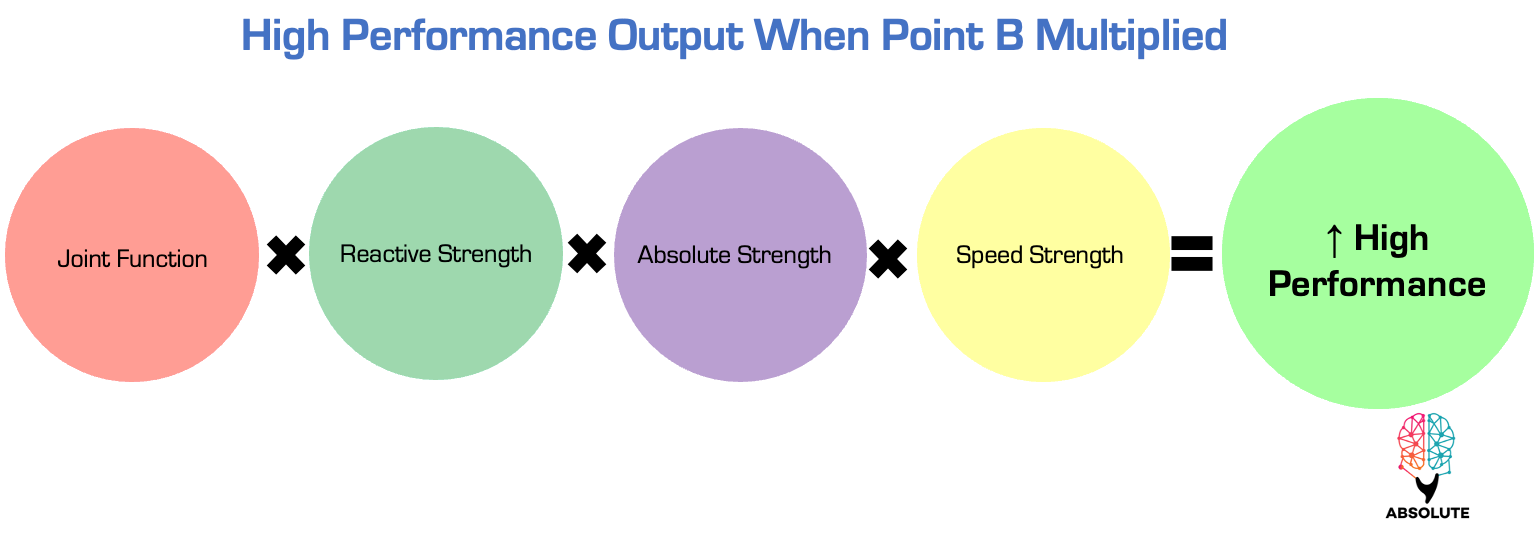
Multiplication Principle & Programming for Point B
Programming for high performance must account for the Multiplication Principle. With the goal being high performance for the athlete, the outcome of any program is dependent upon the interacting combinatorial effects of the training inputs that occur within each training session, within each week of the program over the course of time of the program that leads to the acquisition of multiple of the fundamental physical capacities of Point B. Inherently, this is part of the reason why, the sequencing of each daily input to the system must be considered in real time by the programmer and the athlete so as to attempt to maximize the product of the training.
The central idea of the multiplication principle as it relates to systems is that:
If any one event can happen in M ways, and another event can happen in N ways, then both together can happen in M x N ways.
If this were considered as numbers and M was represented by the numbers 1-10 and N was also represented by the numbers 1-10, it would be easy to see that at the top end (ie 10 X 10) the outcome would equate to a larger product than the lower numbers, even if one of either M or N had a high number. If M was represented by a 10 and N was a 0, the product would be nil—this is the potency of the multiplication principle.
Using a simple practical example of the multiplication principle consider choosing a meal from a small menu at a restaurant. Considering that there may be five appetizers, 10 meal options and five desserts, using the principle it would lead to a potential of 5x10x5 = 250 possible meal options.
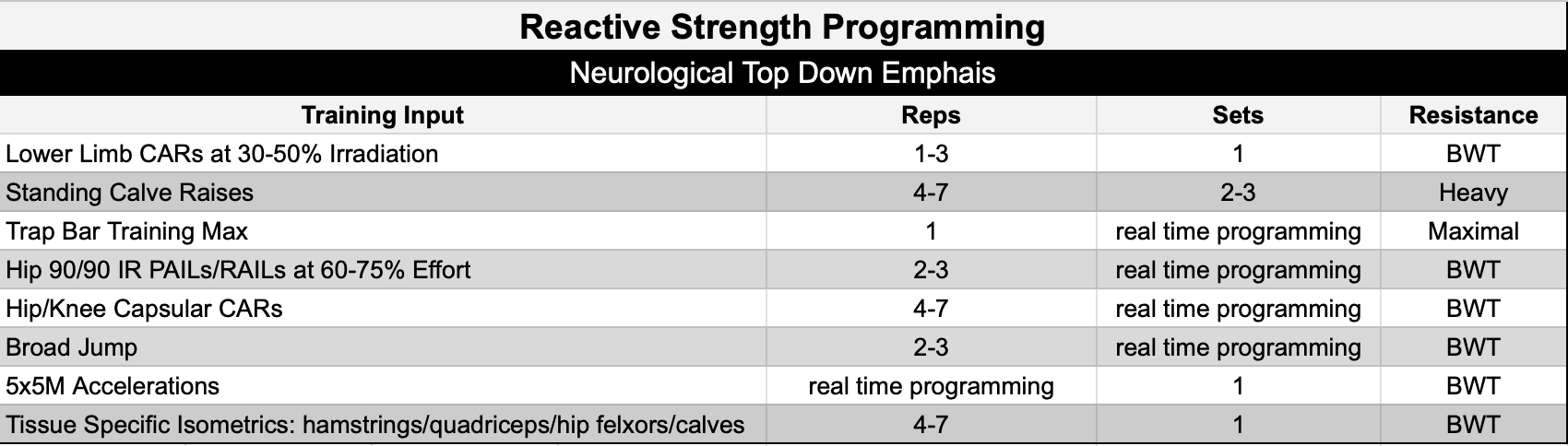
In the view of programming, the application of the principle aligns well within the conjugate strategy. Using the acquisition of Reactive Strength as an example, we know that there is a top down and bottom up component of this behaviour that cannot be fully trained using inputs of one sole means. Embedded within the top down component would be the capacities of Absolute Strength as well as Speed Strength which should be accounted for at certain levels within the program. From the bottom up, Joint Function and Connective Tissue Stiffness must be layered into the program at various levels creating a multiplication grid that includes four capacities that have multiple levels and even more inputs within each level. It is evident to see how the multiplication principle is at work creating the ultimate product of any treatment or training session.
In attempting to maximize the product in each training session, an example for an athlete that requires more neurological output may look like this:
The Programming Shift → Linear to Conjugate
Programming with this in mind leads to a fundamental shift away from linear thinking and toward system stewardship. The programmer’s role is no longer to maximize a single variable, but to protect and enhance the product of all variables simultaneously. Because the output is multiplicative rather than additive, even modest improvements across all capacities yield a disproportionately large increase in performance, while neglect of any single capacity disproportionately suppresses the final outcome.
In practical terms, this means that programming decisions must be evaluated not by how much they improve one quality in isolation, but by how they influence the entire system product. A small gain in Absolute Strength that degrades Joint Function, or an increase in Speed Strength that erodes Reactive Strength, may result in a net loss at Point B—even though one metric appears to improve. The program may look successful on paper while the athlete’s performance ceiling is quietly lowered.
The Multiplication Principle therefore enforces a hierarchy of priorities:
