


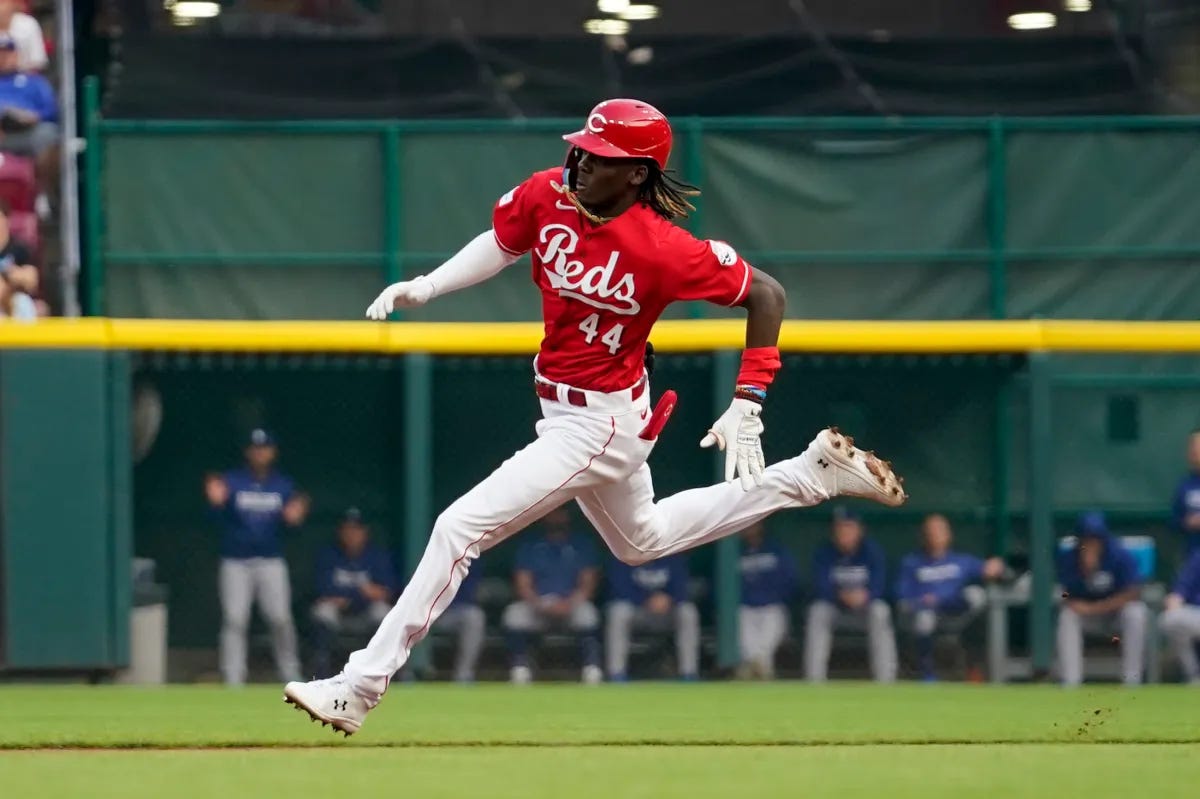
Major League Baseball is becoming our favorite sport to study the science of high performance—because its analytics give us a direct window into Point B neurology in real time.
Just like Paul Skenes, whose data shows a nervous system outputting at the highest level, Elly De La Cruz is another athlete whose neural network of absolute strength is at Point B. The numbers don’t lie.
Baseball’s advanced analytics allow us to observe what matters: outputs at the level of competition. And those outputs reveal insights as to the state of the neural network of absolute strength—and whether it's at Point B, not yet at Point B, trending up, trending down, holding steady or stagnating.
Point A Performance History Reveals Point B Neurology
Even without direct access to Elly De La Cruz’s treatment or training data, his Point A performance history tells us he is at neurological Point B through the feedback loop of speed strength. For example:
He wasn’t just fast—he was at one point in time the fastest in Major League Baseball. That speed strength enabled him to lead the league in stolen bases. These outputs are evidence at the level of competition of Point B speed-strength and a neural network of absolute that can output the emergent behavior of high performance that leads the entire league.
Now overlay that with other elite neurological outputs from the level of competition:
His first Major League home run traveled 458 feet.3
He hit for the cycle.4
He broke the Statcast record for the fastest infield assist (97.9 mph).5
While leading the league in sprint speed, he also recorded the strongest infield throwing arm at 95.6 mph.6
All of these outputs of the neural network of absolute strength on the level of competition tell us that Elly De La Cruz is at neurological Point B.
The Paradox: Stagnation at Point B
But here’s the paradox: an athlete can be at neurological Point B—and still stagnate. In fact, stagnation concurrently with high performance at the level of competition is an indicator that the nervous system has already arrived at Point B. And we believe that’s what we’re starting to see with De La Cruz’s data. Let’s walk through some of the data, our logic and you decide.
Sprint Speed: A Downward Trend
De La Cruz is still among the fastest players in baseball. But his sprint speed trendline shows a subtle yet important decline:
2023: 30.5 ft/sec (1st in MLB)
2024: 30.0 ft/sec (3rd in MLB)
2025: 29.1 ft/sec (currently 40th in MLB)
While he remains well above average (~27 ft/sec), this isn't the trajectory you expect from an optimized Point B neurology. Or is it?
Why the Decline?
Here is three theories we’re considering in regards to De La Cruz drop in speed strength at the level of competition:
1. Neural Cruise Control
The nervous system may be self-regulating, settling into a more energy-efficient output. Maybe 30.5 ft/sec was unsustainable—or unnecessary. If he can still lead the league in stolen bases at 29.1 ft/sec, why output more?
2. Neurological Stagnation
This decline could reflect under-stimulation. The neural network of absolute strength is no longer being constrained to output at its highest attainable speed. It’s outputting just enough—nothing more and keeping reserves. This is a form of neurological stagnation—the best form to have.
