


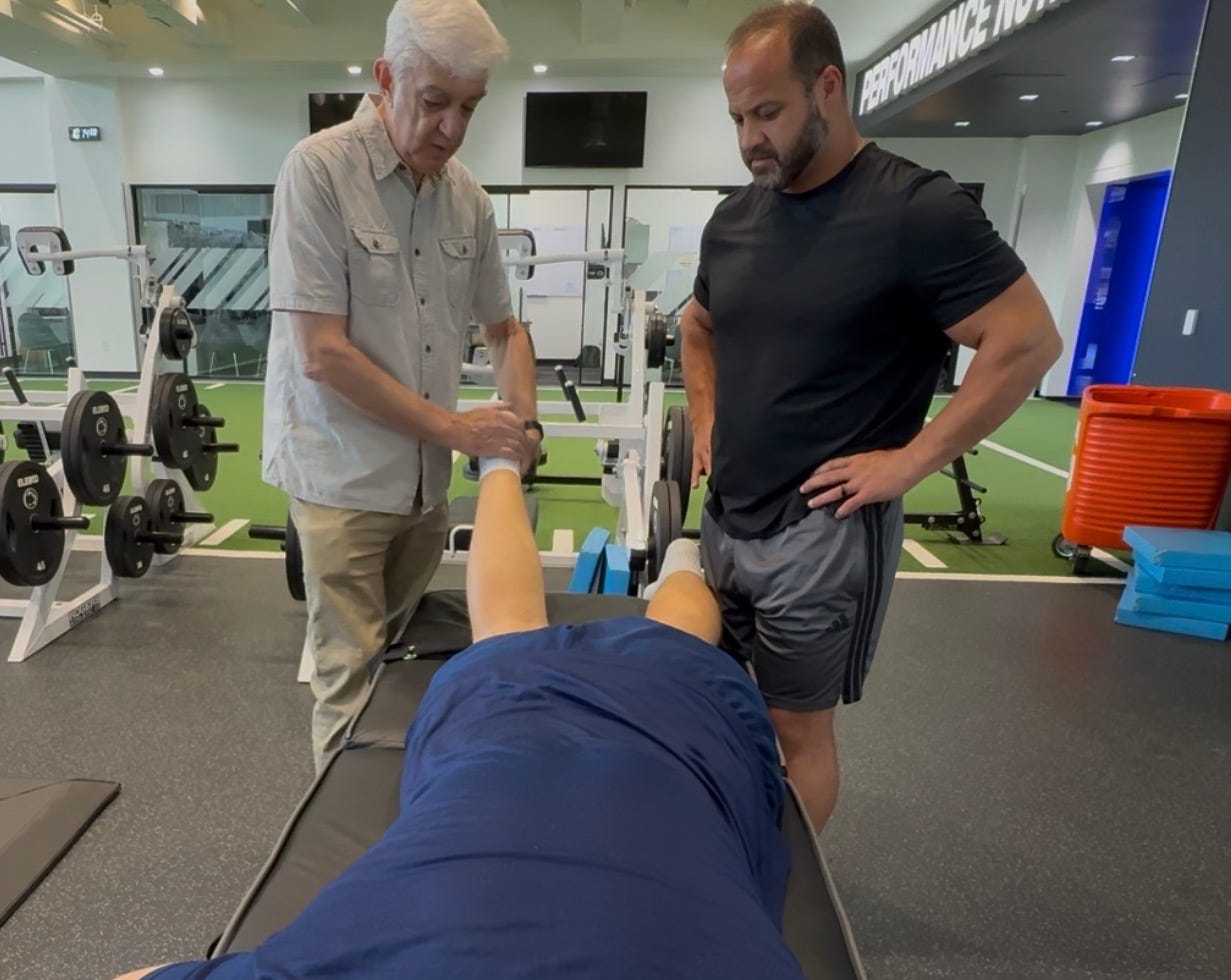
Penn State is a powerhouse of innovation. In 1977, Dan Riley arrived from West Point with a constraint most strength coaches would have accepted: no equipment, too many athletes, and a neck that nobody was programming training work for. He didn’t go looking for a better machine. He put a partner’s hands on the athlete and called it manual resistance. In 1979 he stood up at the national strength coaches convention and handed it to the entire field. It spread because it solved the same constraint everywhere.
Riley programmed it as repetitions. 47 years later we’re using manual resistance to bring velocity to zero and hold in tissue-specific lengths + joint ranges of motion, for a target he never programmed for: reactive strength.
The necks Riley’s programming developed became the template. When Penn State won national titles in 1982 and 1986, Riley was already in Washington, where he’d spend nineteen years and collect three Super Bowl rings. His exercises didn’t travel. His logic did and the football athletes at Penn St had Point B necks we have never seen before.
That’s the part of Penn State most people in the strength world know. The part they don’t is what was happening across campus, where a different group was working out why that logic holds.
Dr. Vladimir Zatsiorsky came to the States in 1990, after 18 years chairing the biomechanics department at the Central Institute of Physical Culture in Moscow. If the name doesn’t register, the book will: he wrote Science and Practice of Strength Training. At Penn State he built the Biomechanics Laboratory, and it worked hand in hand with the Motor Control Laboratory down the hall.
We didn’t meet Riley. We didn’t meet Zatsiorsky. We got onto that campus because the tradition that produced both of them is still alive there.
Reid Kagy hired us to come in during the season. That detail matters more than it looks. In-season is when a performance staff has the least room for anything that isn’t already working, and the opening weeks of a football season are the tightest the calendar ever gets. They gave us their full attention anyway—much respect. They sat through a presentation on Biological Point B and we got into the question underneath all of it: what is the number one limiting constraint in high performance? The answer we brought them was a Reactive Strength Deficit.
Innovation at Penn State isn’t a trophy in their trophy case—but there are a lot of those too. It’s a staff culture. And it’s what put us at the edge of high performance, in the Penn State football weight room with Dr. Mark Latash.
Latash is a distinguished professor of kinesiology at Penn State and the director of the Motor Control Laboratory, which he organized in 1995 alongside Alexander Aruin and two graduate students. He has authored five books, edited ten more, and published over four hundred peer-reviewed papers. He founded the journal Motor Control, served as president of the International Society of Motor Control, and holds that society’s Bernstein Prize.
What Latash has spent forty years on sounds abstract until you realize it’s the same question Riley was answering with his hands. When an athlete produces a task, what is the nervous system actually holding constant, and what is it leaving free? Get that wrong and you program against the wrong variable.
The answer starts with a Blacksmith.
Where it Started
Back in the 1930’s Nikolai Bernstein noticed something very odd. When a Blacksmith swings a hammer, the hammers path is remarkably consistent from strike to strike, but during each swing, the path that the joints producing the movement take was not consistent. Stated in another way, each joint involved in the movement (shoulder, elbow, wrist, fingers) produced a consistent action of swinging a hammer in a multitude of different coordination patterns. At the time, this had not been observed, was entirely strange and as a result was not explained. As a matter of fact, Bernstein thought he had collected inappropriate data. Nevertheless, he ended up terming this the “degrees of freedom problem” which is based on the fact that the nervous system has vastly more moving parts (muscles and joints) than it actually needs to perform any one task effectively. This plagued the field for sixty years before any relevant evidence or explanation.
The Core Idea
The Uncontrolled Manifold (UCM) hypothesis was introduced in 1999 by John Scholz and Gregor Shoner. Their seminal paper introducing the concept provided the field with the beginnings of a possible explanation of what Bernstein observed.
For descriptive purposes it is important to define one foundational piece in the study of movement and its control. Any movement taken in isolation is produced by a set of elemental variables which essentially describe the joint angles and muscle forces needed to produce that movement. In relation to Bernstein’s observations and the proposed UCM hypothesis, we can take any task, and understand that it can be produced with a hugely diverse set of elemental variables such that there is a large number of configurations of joint angles and forces that will ultimately produce this movement outcome. If all of the combinations of the elemental variables that produced the intended outcome were to be plotted, it would trace out a subspace within a full space of possibilities. That subspace is the Uncontrolled Manifold.
The name is a little counterintuitive. "Uncontrolled" doesn't mean ignored. It means that the nervous system doesn't need to correct deviations that stay inside this subspace, because such deviations don't change the outcome that matters. Movement within the UCM is free and therefore “uncontrolled” specifically. Movement that pushes off the UCM and goes in a direction that would actually change the task-relevant outcome which changes the intent of the movement is exactly what a well-organized controller should suppress.
Getting back to Bernstein, the application of the UCM explains what he observed: each Blacksmith had the intent of hitting the hammer to a spot on a chisel, which determines the acceptable goal as an outcome of the movement. Within that goal, was displayed numerous configurations of joint angles and forces that produced it. What Bernstein actually observed is the subspace of a Blacksmiths hammer swing, which we now know as the Uncontrolled Manifold.