


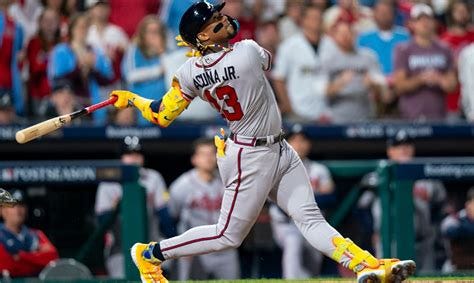
Recently it was reported that Ronald Acuña Jr was getting closer to his return to the Atlanta Braves lineup after finishing his second game on his current rehabilitation stint in the minor leagues for his second hamstring strain this season.
Acuña Jr who has immense baseball skill has dealt with repetitive injury issues, specifically in his legs in each of the last five years. When healthy, he is a devastating player for opponents as evidenced by his 2023 NL MVP award.
Despite his prowess, since 2021 he has been forced to battle through numerous setbacks that have stolen time and production from his baseball career. Here is a chronological list of his injuries:
Acuna Jr’s Injury Timeline
July 2021: Acuña tore his right ACL, ending his season mid-way through what was shaping up to be an MVP-caliber year.
May 2024: Acuña tore his left ACL on a non-contact baserunning play—he planted his left foot trying to redirect back to second base and his knee gave way. He missed the remainder of the 2024 season after an MRI revealed a complete tear, suffered on a non-contact play while running the bases. Surgery was performed by Dr. Neal ElAttrache in Los Angeles, who had also performed the 2021 procedure.
May 3–18, 2026: First left hamstring strain of the season, also sustained while attempting to run out a grounder.
June 9–11, 2026: Second left hamstring strain in the same season. He was placed on the 10-day injured list with a Grade 1 left hamstring strain after exiting a loss to the White Sox the day before, having injured himself running out a ground ball. Manager Walt Weiss noted it didn’t appear as severe as the previous strain but would still require time to heal.
Even though his initial setback was on the right leg with the ACL tear, subsequent to the same injury in 2024 on the left side, he has suffered from repeated hamstring strains—reactive strength injuries, exhibiting the exact same mechanism.
Why the Same Leg Matters
The connection between a prior ACL reconstruction and a subsequent hamstring strain on the same limb isn’t just narrative—it’s a recognized pattern in sports medicine, for a few overlapping reasons:
1. Graft-related muscle deficits (if a hamstring graft was used). One of the most common ACL graft sources is the patient’s own hamstring tendon (typically the semitendinosus, sometimes with the gracilis). Research comparing graft types found that while quad tendon grafts showed a transient quadriceps strength deficit that fully resolved by return to play, hamstring grafts showed both quadriceps and hamstring strength deficits that never fully recovered. If Acuña’s graft was harvested from his own hamstring, that tendon is now structurally different and permanently weaker than it was pre-surgery—a very plausible substrate for recurrent strains (Acuña’s specific graft type hasn’t been publicly reported).
2. Altered biomechanics and compensation patterns. Even when the graft doesn’t come from the hamstring, ACL reconstruction changes how the entire kinetic chain of that leg functions. Rehab focuses heavily on rebuilding quad strength and knee stability, and athletes commonly develop compensatory movement patterns—altering stride length, hip extension, or deceleration mechanics to protect the reconstructed knee. Unfortunately, in some cases the athlete will progress through rehabilitation such that these alterations will not manifest until the athlete has returned to the Level of Competition. Obviously this has the potential to shift load onto the hamstring in ways the muscle isn’t conditioned to absorb under the constraints of sport, especially during high-speed, high-eccentric-load actions like sprinting out of the box or decelerating into a bag.
3. Residual neuromuscular deficits. ACL tears don’t just damage the ligament—they disrupt sensory feedback and neuromuscular control throughout the limb. Studies on ACL-reconstructed athletes consistently show measurable strength and activation asymmetries between limbs that can persist for years, even after athletes are cleared to “full” activity. This is the importance of the neural network of absolute strength. A hamstring operating with imperfect neuromuscular coordination is more vulnerable to a strain during an explosive, uncoordinated moment—like Acuña “beating out a grounder,” which is precisely how both 2026 strains occurred.
4. The general pattern of reduced durability. Beyond the specific hamstring mechanism, there’s a broader and well-documented finding in the sports medicine literature that lower-body soft-tissue injuries cluster and recur—an ACL tear meaningfully raises the risk of subsequent injuries (hamstring, quad, groin, calf) on the same leg for years afterward, even absent a single clean causal link. Acuña’s injury history is “the critical variable” for his hamstring strain specifically, considering he spent much of 2024 rebuilding movement patterns and lower-body mechanics from scratch after the ACL tear and subsequent reconstruction. Considering we wrote about durability as a quality possessed by the athlete individually, that is characterized by ecological efficiency, any injury that creates reverberations through the system has the potential to decrease it.
Point A: The Diagnostic Starting Point
Within the Absolute model of high performance, Point A synthesizes four lenses—Physical Assessment, Health History, Performance History, Training History—before any programming happens. Acuña’s Health History alone is a flashing yellow signal. Given that a prior ACL injury carries roughly 2.2–2.25x greater risk of a future hamstring strain, his Point A profile wasn’t just “athlete recovering from knee surgery”—it was “athlete in a documented high-risk category for subsequent (hamstring) injury on that same leg.”
Absolute has no inside information regarding Acuna Jr or his management through the Braves medical staff or any of his potential private health team. Having said that, if his programming managed the 2024 ACL rehabilitation as solely a knee problem to solve and then handed him back to general baseball conditioning, that’s an incomplete Point A being carried forward into an incomplete strategy—exactly the failure mode the framework warns about.
The remainder of this article—covering which of the four capacities (Joint Function, Absolute Strength, Speed Strength, Reactive Strength) most likely broke down in his return-to-play programming, why a hamstring can pass a strength test while still carrying a CNS-level activation deficit, and what a properly conjugated strategy would look like for an athlete with Acuña’s profile—is available to paid subscribers.
If the Absolute Conjugate Strategy is new to you, the learning module is the right place to start: The Art & Science of Programming—Absolute Sport Science
