


Defining the Reactive Strength Problem: Rejecting Bad Explanations for the 49ers’ Limiting Constraint
At the Level of Competition, where human performance pushes against biological limits, recurring reactive strength injuries often signal deeper systemic issues. For the San Francisco 49ers, a pattern of connective tissue failures has amplified into an acute + chronic limiting constraint, hindering their Super Bowl aspirations and sparking widespread speculation. This pattern exemplifies what we at Absolute Sport Science term the “Reactive Strength Problem”—a fundamental mismatch in how athletes’ bodies handle the explosive, reactive demands of load transmission, such as cutting, jumping, or decelerating.
Reactive strength, as a complex special strength from the inside-out, encompasses the athlete’s ability to rapidly absorb, store, and redirect energy during dynamic movements.
The core problem traces back to a legacy definition inherited from early sports science, which views reactive strength predominantly through a top-down neurological lens, emphasizing the assessment and programming of this special strength predominantly neurology while ignoring the bottom-up roles of connective tissues like tendons, ligaments, and fascia.
This neuro-centric paradigm inadvertently generates a neurological-biological asymmetry: the nervous system optimizes force output, outstripping the connective tissue network’s capacity to manage and transmit those loads. The result? Tissue degradation—see the Major League Baseball’s UCL epidemic, chronic shielding, tightness, and ultimately, reactive strength injuries. In the 49ers’ case, this asymmetry has amplified, fueled by viral narratives that misdirect attention.
Drawing on David Deutsch’s philosophy from The Beginning of Infinity, we must reject bad explanations—those easily varied, lacking predictive reach, and failing to inspire progress—in favor of good ones. The “power plant” story, blaming electromagnetic fields (EMFs) from a nearby facility, epitomizes a bad explanation: it bends to fit facts post hoc, ignores inconsistencies (like the facility’s long history without prior reactive strength injury surges), and diverts from internal dynamics, chasing environmental ghosts instead of addressing the neural-biological asymmetry.
At Absolute, our inside-out model of reactive strength offers a better explanation, conjugating neurology and biology, enabling strategic programming that prevents amplification—it dampens this asymmetry and utilizes the neurological, specifically the neural network of absolute strength to cultivate the biology, develop it to have the multifaceted behaviors of reactivity.

The Viral Explanation: Why Blaming the Environment Falls Short
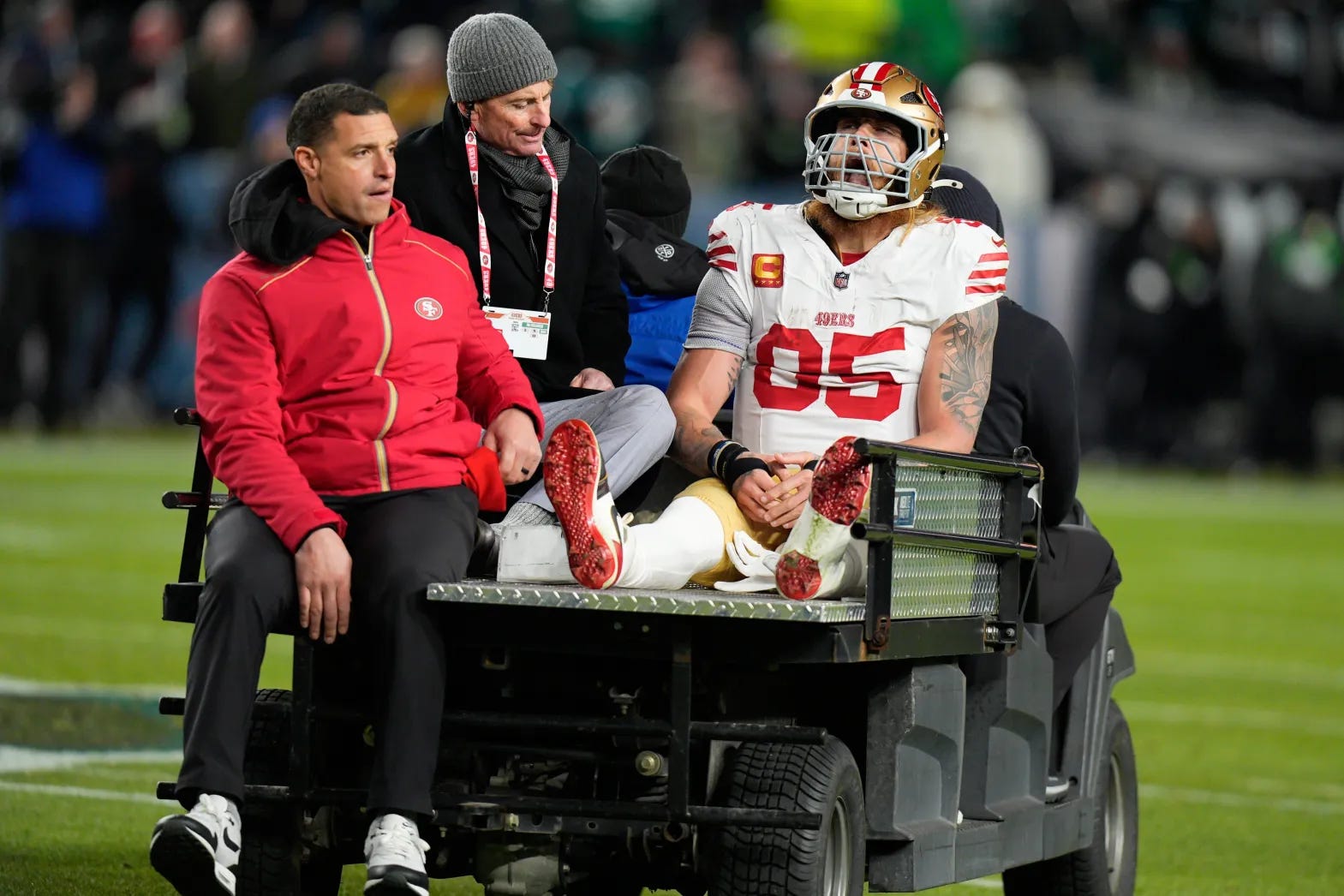
The narrative attributing the 49ers’ injuries to electromagnetic fields (EMFs) from their Santa Clara practice facility surged in popularity after more reactive strength injuries like George Kittle’s Achilles rupture in the playoffs, which highlighted the this amplifying problem. While dramatic and simple, this explanation falters under scrutiny: it lacks testable mechanisms linking EMFs to tissue weakening, fails to account for why issues emerged recently despite the facility’s decades-long operation, and overlooks why similar problems don’t affect other teams in comparable settings.
Critically, it misallocates focus toward external remedies like relocation, bypassing the internal neurological-biological asymmetries at play. This virality stems from its accessibility but ultimately distracts from a systems-level understanding, perpetuating legacy programming paradigms that prioritize neural outputs over connective tissue readiness and constraining proactive programming solutions.
Redefining Reactive Strength: An Inside-Out Perspective
Reactive strength emerges not as a mere top-down output from the nervous system to the muscles, but as a synergistic behavior arising from the athlete’s neural network of absolute strength and biological connective tissue network. Legacy paradigms, rooted in Soviet-era training, focused on external metrics like jump height or ground contact time, focusing on the neurological behaviors. This neurological overlooking created a biological blindspot—specifically, the architecture and behavior at the connective tissue level.
At Absolute, we credit the Soviet’s but this is 2026 not 1986. We are in a different paradigm, a reactive strength paradigm. Like you, our ambition to not survive—it is to thrive. That lead us to redefine this complex special strength as an inside-out phenomenon.
The Soviets would have appreciated reactive strength as a conjugation of the neurology and biology. It would become apparent that the Reactive Strength Index (RSI), while useful, has historically limited our understanding by fixating on neurological behaviors rather than biological ecologies, masking how disruptions in synergies lead to faltering performance. By integrating these layers, our model (explanation) reveals why athletes like the 49ers’ are constrained: not from “power plant,” but from neurology that outpaces biology due to suboptimal programming strategies due to a legacy definition.
Neurological-Biological Asymmetry in Action: Case Studies from the 49ers
Real-life examples illuminate our inside-out model of reactive strength as a good explanatory feedback loop. Dre Greenlaw’s Achilles rupture in the 2024 Super Bowl—during a routine jog, non-contact—might seem like misfortune under legacy views. Those views is what is having the 49ers General Manager Jon Lynch look tell the media he is looking into this explanation.
Our model interprets Dre Greenlaw’s prior shielding as the neural network of absolute strength protecting abnormal connective tissue from loading, but over the course of the season and playoff run to the Super Bowl, fatigue eroded the neurological barrier, allowing load to transmit into degraded connective tissue architecture, resulting in catastrophic tissue failure.
George Kittle’s season-long lower extremity tightness, culminating in a playoff Achilles rupture, exemplifies shielding’s role: the nervous system, via muscle spindles, constrains tissue length to unload compromised tissues. Amid escalating competition, this protection fatigues, heightening catastrophic tissue risks—a leading indicator of reactive strength deficits.
More specifically with Kittle, on the same side where you do not see the behavior of reactive strength but the rupture of abnormal connective tissue, understand he had been getting leading indicators all season. He missed games with a tight hamstrings. Then an ankle. See how from a load transmission reactive strength lens this is neurological shielding? What happens when the nervous system cannot compensate anymore for the biology is exactly what we saw play out this year with Kittle, unfortunately.
Christian McCaffrey’s bilateral Achilles tendinopathy further highlights the doom loop: rest the neurology instead of utilizing the neural network of absolute strength to stimulate the connective tissue network, thus instead prompting tissue degradation. His progression from tightness in conjugation with tissue degeneration underscores the bottom-up challenge in complexity with this special strength, where shielding enables athletes to compensate for not being at reactive strength Point B.
These real life cases reveal the Reactive Strength Problem on the 49ers and the NFL. This is not a monkey on their back but a gorilla. Our explanation also has the reach to create new knowledge, specific programming knowledge that allows us to solve this problem and shake the gorilla off our backs.
Neurological Shielding: A Leading Indicator of Reactive Strength Problem
In our programming learning module we teach neurological shielding is a leading indicator of this asymmetry—a behavior of the neural network asserting agency to restrict joint range or tissue length, safeguarding against load transmission. Envision it as Chesterton’s Fence: a neurological barrier not to be dismantled with modalities like dry needling or theraguns (which is a sponsor of Christian McCaffrey and the NFL), but to be investigated through assessments of connective tissue behavior. If abnormalities surface—such as irregular tendon elasticity, abnormal length tension ratios or epimyseal restrictions—strategic programming normalizes the biology, allowing the shielding behavior to recede because the athlete is getting closer to Reactive Strength Point B.
This shielding directs us to assess specifically for reactive strength and joint function, providing information flow that maps Point A (current state) to strategize toward Point B (optimal physical state). Please understand that assessing for reactive strength is different than assessing for joint function. They are two different elements of Point B and to get a Point A you need to overlay assessments from both.
Chronic Tightness and Real-Time Programming: Reframing Signals for Adaptation
Chronic tightness framed as invaluable feedback about an athlete’s biological Point B—a symptom of underdevelopment, not a symptom to dry needle away. Also learn from the Pittsburgh Steelers medical staff, that dry needling has its own risks—they punctured the lung of a future Hall of Fame player TJ Watt. Watt had surgery to repair a partially collapsed lung right when the Steelers were trying to make a playoff run—a massive limiting constraint on the organization.
Neurological shielding signals the need for bottom-up stimulation via the Internal Isometric Continuum. We have isometric cheat sheet that allows for specific isometrics to get programmed from either the neurology, biology or both, in real time. As inputs are optimized for each case, the programmer will see the shields drop in real time, showcasing the neural network’s responsiveness. The game is to get the shield to lower so that you can stimulate the connective tissue. To do so requires programming in real time.
This necessitates adaptive strategies over fixed protocols and plans—iterative feedback loops where programmers, versed in a modern understanding of reactive strength from the inside, leverage neurology to stimulate biology, adjusting stiffness or dampening as indicated. That is what wresting with reactive strength looks like in real time—it’s actually fun and the athlete learns in conjugation with you.
Bridging Silos: Communication and Strategy in High-Performance Teams
Miscommunication between football and performance staffs only amplifies reactive strength problems, turning isolated vulnerabilities into organization-wide limiting constraints. This gap underscores the need for football coaches to view strength coaches not as support staff, but as a coordinator whose feedback informs smarter on-field decisions—like calibrating practice intensity to avoid bottom up tissue overload.
Take Kyle Shanahan: a master offensive play caller, he should understand reactive strength from an inside-out perspective, recognizing it as the acute + chronic limiting constraint that’s led the 49ers to chase distractions like the power plant narrative. Yet, Shanahan is a football coach first; he hires experts so he doesn’t have to dive into the science himself. That’s precisely the point—his performance staff exists to generate this knowledge into actionable information flow, such as real-time assessments of tissues like the Achilles tendon. If the football staff is pushing load transmission too aggressively in practice, this information flow provides the necessary checks, preventing the neural-biological asymmetry from spiraling.
Strength coaches are on the staff for this very reason: to bridge the silos with data that goes beyond legacy metrics like RSI, which trap us in a neuro-centric loop—what Einstein might call the definition of insanity, repeating the same top-down emphasis and expecting different outcomes. By integrating biological information flow, this communication generates a unified strategy, where everyone—from sideline to weight room to clinical staff—works toward Point B.
