


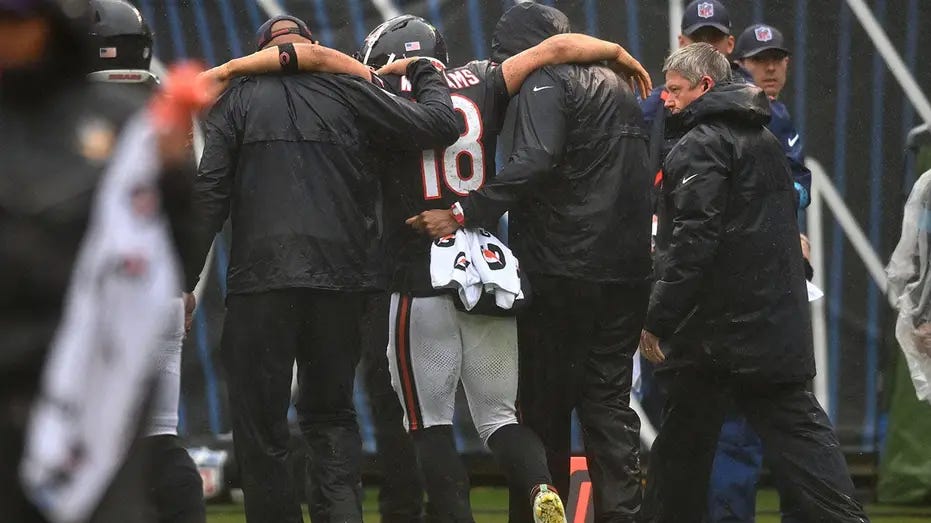
Caleb Williams is at Neurological Point B. He’s a highlight reel, the franchise quarterback, the reason the Bears came into 2026 with real Super Bowl expectations. Late in the fourth quarter against the Vikings, a single scramble put his neurology in front of a demand his biology had never been programmed to meet.
No one touched him. The connective tissue of his hamstring had to damp the energy of a landing at full tissue length, and it couldn’t. Was there bad luck involved? Some. A water saturated field, a diving defender, a scramble at the wrong angle. But luck only sets the conditions. The tissue’s capacity decides the outcome. The Level of Competition is rarely optimal, and on that day it exposed a Reactive Strength Deficit. The good news: the deficit is fillable.
In Sunday’s video, we broke the play down frame by frame. Here’s what we saw.
Point A: The Mechanism at the Level of Competition
First-and-goal from the 6, trailing 6-3, about eight minutes left. Williams escapes around left end and senses the defender diving at his legs. To clear him, he drives his right knee up, flexing hard at the hip and knee. Then, as the leg reaches back for the ground, the knee extends with the hip still flexed. In a fraction of a second his right hamstring goes from short to full tissue length.
Then he plants, at full length, in cleats, on a natural grass field that had been soaked by heavy rain before the first snap. As we covered Sunday, a saturated field changes what the ground gives back on every plant. The energy that arrived at Williams’ hamstring didn’t match anything his tissue had experienced. Situationally, it was a bodyweight (relative strength) overspeed eccentric at tissue length, on a surface the tissue had never learned to damp against. That’s about the most reactive demand you can put on a hamstring.
At that moment the tissue had one job: damp the energy and transmit the force directionally north-south through the chain. It damped partially, then yielded.
He saw the defender coming and pulled his knee up into more hip flexion. His nervous system organized around avoiding contact. What it couldn’t anticipate was the ground. The tissue met a demand it hadn’t prepared for, on a surface the neurology had never learned to damp against.
To us at Absolute, damping is a programmable quality. The tissue’s ability to absorb and dissipate energy can be trained and progressed over time, just like strength or speed. We laid out why in The Damping Effect: A Programmable Quality, and how it plays out in time in Reactive Strength In Time Programming: Understanding The Damping Effect. On this play, the demand for damping arrived faster, at greater length, and in a less familiar form than Williams’ connective tissue and neurology was prepared for. It’s also why pendulum damping is something we program for directly in our Reverse Hyper strategy.
Watch where he grabs. It’s the middle-to-upper back of the thigh, which suggests the muscle tissue at the musculotendinous junction took the damage. That’s what happens when connective tissue is constrained at length, it does not have access to more length to damp the load. The energy has to go somewhere, and the muscle tissue is where it went.
Point A: What Williams Brings
Neurologically, he’s elite, with a network of absolute strength and speed that makes him one of the most dynamic quarterbacks in football. As far as the public record shows, he has no hamstring history.
So where’s the gap—the deficit? It’s tissue-specific. The proximal-to-middle region of the hamstring is one of the least trained areas in sport. Hinges and deadlifts load it, but most programs use those lifts for their neurological effect, not to teach that tissue to damp and transmit force at length. The neural network gets built while the tissue never gets the stimulus of damping.
The Diagnosis
This is a bottom-up reactive strength injury, driven by what we call a Reactive Strength Deficit: the gap between neurological output and the connective tissue’s ability to damp and transmit that output. Top-down, the neurology held. Bottom-up, the reaction never emerged. We’re reading film, not imaging, but the mechanism is about as clean as they come.
The diagnosis matters. Call it a “hamstring strain” and the default is rest, time, and a return-to-play checklist. The tissue heals, but it doesn’t learn reactivity and damping. Call it a Reactive Strength Deficit and the medical and strength staffs share one programming target: developing a special strength. Every day Williams is out becomes a day of programming, not a day of waiting.
The Dead Money
In 2024 we ran the numbers on the NFL’s Reactive Strength Problem and the dead money teams pay players who are on the roster but sidelined by connective tissue injuries. Apply the same math to Williams.
His contract averages $9.87 million per year. Over a 17-game season that’s roughly $580,677 per game. Four games on the sideline comes to $2.32 million in reactive strength dead money.
And that’s the cheap version, because he’s still on his rookie deal. His extension is projected at $55–62 million per year. At that price, the same four-game absence would cost the Bears roughly $13–15 million.
The Prognosis
Here’s the encouraging part. An athlete already at Neurological Point B is in about the best position possible to come back from this. The programmer just has to solve one highly specific and nuanced problem.
We believe this can be a fast return, three to four weeks, provided it’s what the film suggests. But return has to mean something specific: connective tissue that is reactive and behaves elastically, not tissue that is merely usable that he compensates for. Getting there in-season takes the medical staff and the training staff programming in conjunction.
That’s the Hidden Layer, and how we would shape the strategy.
Programming the Hidden Layer
We don’t know anyone on the Bears staff, and we don’t have Williams’ imaging or physical assessment findings. So treat what follows as a model of how we would program this case from the moment he came off the field, not as a report of what’s happening in Chicago.
Time is of the essence, as the NFL season doesn’t pause. The Bears play every week whether Williams is available or not. Every day he’s out has to count, which means treatment and training can’t wait on each other. They have to run in conjugation from day one.
This is where the Hidden Layer of programming either emerges or it doesn’t. The inputs are well known: isometrics, eccentrics, the reverse hyper. But treatment and training is not programming. Treatment and training are the inputs. Programming is the regulation of those inputs over time, driven by real time feedback. We broke down that distinction in The Hidden Layer: Training vs. Programming. In Williams’ case, every session produces a new Point A, and every new Point A tells you what the programming options are for the next session.
We’ve covered the first two phases of hamstring reactive strength injury management before. Here’s how each applies to Williams.
Phase 1: Initial Management
The first priority is getting the neural network of absolute strength back into the injured tissue. A hamstring that has just yielded is surrounded by protective neural output. We call this neurological shielding.1 The CNS is shielding the tissue and joint range of motion, and until the network reconnects to the tissue, biological loading won’t optimally stimulate the injured tissues.
The skill is palpation and the input is IsoRamping. Palpation finds the injured tissue and tells us how it is behaving. IsoRamping then asks the neural network to generate force into that tissue, slowly ramping effort while we give it feedback through our hands. We walk through a live acute case in Initial Hamstring Injury Management: Palpation + IsoRamping.
From there, the Internal Isometric Continuum organizes everything. PIMAs, pushing or overcoming isometrics, serve two purposes early on. They’re analgesic, calming the pain response. They’re also diagnostic: the effort level at which force transmission starts to feel abnormal becomes a number we can track, a programming feedback loop. That number is the thread that runs through the entire return. We laid out the continuum for acute hamstrings in Initial Hamstring Injury Management and the companion video.
Then comes volume, which is where most rehab plans fall short. Research shows connective tissue responds to about 10 minutes of loading, then needs roughly six hours before it becomes responsive again.2 So we go Bulgarian on the biology: isometric loading three times a day, six hours apart.3 That’s 21 sessions in the first week alone. The loading starts immediately. We don’t and can’t wait for the tissue to calm down, because the tissue remodels according to the load it receives.
One more programming feedback loop to monitor is neurological shielding, experienced by the athlete as tightness. If the hamstring presents as tight, that’s a protective neural output, not a tissue that needs stretching. Stretching, scraping, or foam rolling it amplifies the shielding and adds noise into this feedback loop that we cannot have with the time constraints we are operating under. IsoRamping and positional isometrics resolve it. We covered this in Hamstring Tightness: A Neural Network Approach to Treatment.
Meanwhile, the rest of Williams’ neural network doesn’t go dormant. We utilize upper body neurological training to stimulate the neural network to output force expression, which lowers the amount of shielding that we get in the hamstrings. Lower body joint function training continues. The aim of the program is to return Williams with more reactive strength throughout the entire lower body.
Phase 2: Intermediate Management
Once the neural network is reconnected and the PIMA effort output is climbing, the intent shifts from protecting the tissue to developing it, specifically toward length. The tissue failed at length, so length is where it has to be rebuilt.
