


Welcome to Installment #03 of The Conjugate Edge. Each month, we publish one essay designed to help programmers in strength and clinical settings step off the linear path and onto our conjugate strategy—one that propagates athletes from Point A→ Point B. This is the programmers go-to source for the most up-to-date thinking on Conjugate—not as a method, not as a system, but as a living programming strategy that treats and trains concurrently in real time. Want to join the conversation? Become a paid subscriber to access comments and our private chat. Want to go deeper? Check out our online course: The Art & Science of Programming.
Our Name Has a Story
We get asked all the time—why Absolute? Where did the name come from? Does it mean something?
It does. And after launching our Learning Module: The Art & Science of Programming, now feels like the right time to tell that story.
The Soviet Discovery
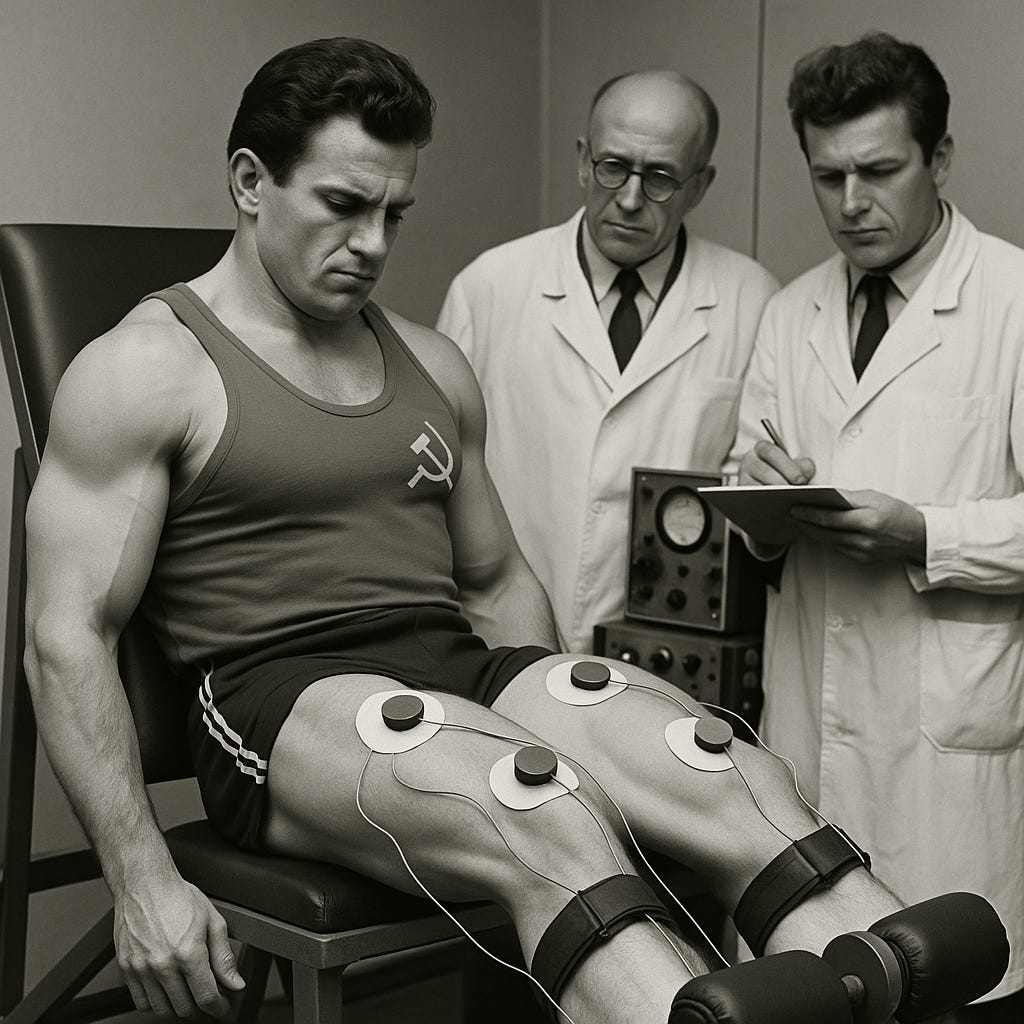
Decades ago, in the 1970s, Soviet scientist Dr. Yakov Kots made a discovery in a lab that still sends chills down our spines. He proved that there’s a difference between maximal strength and absolute strength.1
Maximal Strength is the greatest amount of force an athlete’s neural network can voluntarily generate.
Absolute Strength is that, plus the reserves hidden within the neural network of absolute strength.
Kots placed electrodes on the muscles of trained athletes and ran electrical currents through them, depolarizing motor neurons and triggering involuntary muscular contractions.
The result? Their muscles produced 30–40% more force than they could voluntarily.
That meant even the most highly trained athletes were only tapping into a fraction of their potential. There was a measurable gap—a reserve—between what the human nervous system allows and what the muscle can truly ouput.
That gap would later be known as the Muscular Strength Deficit (MSD).2
The Hidden Potential
Dr. Vladimir Zatsiorsky, one of the architects of Soviet sport system, first described this phenomenon as the “hidden potential” of a muscle in the old Soviet manuals. It wasn’t until the 1990s—after the collapse of the Soviet sport system—that he finally revealed it to the rest of world in The Science and Practice of Strength Training, naming it the Muscular Strength Deficit (MSD).
The very existence of the MSD indicates that human muscles typically have hidden reserves for maximal force production that are not used during voluntary efforts.3
Why the delay?
Because during the Cold War, sport was a Hot War. Olympic competition was a geopolitical battlefield. And the Soviets had a stranglehold on it.
Understand: Sport was (and still is) a zero-sum game, and when you’re the one doing the strangling—you don’t stop by choice…
The Race for Neurological Scaling
Once the Soviets uncovered the hidden reserve between maximal and absolute strength, the race shifted from lifting weights to programming the nervous system.
As a result of this specific programming intent, the Max Effort and Dynamic Effort Methods emerged. Methods that the innovators specifically stated are there to scale the nervous system—and the Soviets couldn’t have been more right and concurrently specific.
Whoever could program faster closure of the MSD would neurologically dominate the Level of Competition. It was no different than the nuclear arms race—this was a neurological programming race. A race that the Soviets would win, time and time again—that is until the Bulgarians did what needed to be done and slayed the Russian Bear.
The Race Didn’t Stop …
At Absolute, that’s the same race we’re in—only we’ve evolved it. We don’t just program for neurological scaling; we program to scale biology and conjugate the two into one unified physical state we call Point B.
Our strategy aims to tilt the playing field asymmetrically in our favor—as much as we can. Like the Soviets, we are not looking for a fair fight, we are looking to win, to dominate, the zero-sum game of programming for high performance.
To be brutally honest, our intent is to be the ones doing the strangling—because the inverse isn’t a world we’ll live in. That’s what drove us here to the Conjugate Edge. Welcome—it’s good to see you here too…
Programming the Hidden Potential
This discovery wasn’t just physiological—it was philosophical. Once you understand that strength has reserves, performance problems start to look like programming problems.
Every time we use the Maximal Effort Method, we stimulate the same neural behavior that Kots did with EMS—only now, through programming load, effort and intent. We program constraints to force the neural network of absolute strength to access more of its reserves and actualize them into reality.
Understand: We are asking the nervous system to output everything it has, plus some of those reserves—its going to be internally violent and that exactly the chaotic conditions we need to close the MSD—to stimulate hidden potential to emerge into reality.
Once the athlete is at Neurological Point B, our strategy leverages that neural network to fortify the biology it has access to. You know conjugate the neurology with the biology. In simpler words, we leverage Neurological Point B to get the athlete to Biological Point B.
This is conjugate programming in 2025. This is not your legacy conjugate programming of the 1970s and 1990s—this is 2025.
It is fucking potent—you should try it.
It positions athletes to be explosive and violent at the Level of Competition—the prerequisites to break new ground at that zero sum level while in conjugation suffocating the competition. You know, doing what needs to be done, like the Bulgarians did.
Point B: Generator of Asymmetries at Level of Competition
The programming objective is not make things equal at the Level of Competition. We don’t want a fair fight. We want to own the asymmetries.
That means Point B is the destination at then of the roadmap—the optimal physical state where hidden potential transforms into high performance output.
Through programming specific stimulatory treatment and training in conjugation, we usher that potential into reality. Once an athlete reaches Point B, the asymmetrical advantage is ours—just as it once was for the Soviets in the 1970s.
The difference? We’re not constraining the strategy behind an Iron Curtain for twenty years. We’re sharing it in real time.
This is how you weaponize programming.
This is how you tilt the field.
This is The Art & Science of Programming.

