


Welcome to Installment #11 of The Conjugate Edge. Each month, we publish one essay designed to help programmers in strength and clinical settings step off the linear path and onto our conjugate strategy—one that propagates athletes from Point A→ Point B. This is the programmers go-to source for the most up-to-date thinking on Conjugate—not as a method, not as a system, but as a living programming strategy that treats and trains concurrently in real time. Want to join the conversation? Become a paid subscriber to access comments and our private chat. Want to go deeper? Check out our online course: The Art & Science of Programming.
Louie used to talk about them in the Dead Room. I’d have my hands in his tissue—conjugating between palpation and treatment, and he’d be talking—about Dyachkov, about the manuals he had bought through Bud Charniga, about the fact that the Soviets had people whose entire job was the science of sport. Not coaches who read. Not doctors who lifted. Scientists, employed by the state, studying the athlete as a system. That was how the Soviets built Exercise Science, he’d say. They paid people to figure it out.
He talked about them the way you talk about a species that lives on another continent. Real, documented, and not here.
In the fifteen years since, we have educated performance staffs across professional sport. You hear it constantly. We have a sport scientist. We have a whole department. You hear it, you nod, and you go work with the strength staff and the medical staff and the athletes, and the sport scientist is a name on an org chart you never meet.
Until August, at Elite Athletes Center, in the Dominican Republic. Where one of them signed up for our Baseball as a Special Strength course.
What a Soviet sport scientist actually did
It is worth being specific about what the Soviets actually built, because the word has drifted—but that is our lineage. It is the heartbeat of our conjugate strategy, and it is alive.
The best account of it in English is still James Riordan’s Sport in Soviet Society, published in 1977—the first serious academic study of the subject, written by an Englishman who had actually worked inside the Soviet system and had access to primary sources no other Westerner could get to. What Riordan documents is not a training philosophy. It is an institution: physical culture written into state policy, sport tied to labour and defence, a national apparatus with budgets, ranks, research institutes and a career ladder.
That is the part that gets lost when American coaches say the Soviets. There was no Soviet secret. There was a Soviet payroll.
By 1935 the USSR had a Unified Sports Classification System that ranked not only athletes but coaches—expertise itself was given a rank, a standard, and a ladder. That is a strange thing to do unless you believe that knowing how to develop an athlete is a technical discipline with correct and incorrect answers. By the late 1970s there were thousands of researchers working inside that apparatus, publishing across dozens of periodicals in circulations that would embarrass most of what passes for sport science literature today.
So when Louie said the Soviets had sport scientists, he was not describing a job title. He was describing a state that had decided the development of an athlete was a research problem, and then funded it like one for seventy years.
And the lens was primarily physics—but only as far as Newtonian physics goes.
Zatsiorsky is the clearest case. Open Science and Practice of Strength Training anywhere and you are reading force, velocity, work, and the relationships between them, described precisely. That is the measurement language, and it is Newtonian.
What it is not is a model of the athlete.
Soviet physiology spent the better part of a century dismantling the idea that an organism answers an input the way a beam answers a load. Neurophysiologist Nikolai Bernstein took apart the reflex arc and showed that movement is continual correction rather than execution—the same intention never produces the same command twice, because the body it is issued into has already changed. Pyotr Anokhin replaced the arc with a functional system: a loop that carries an anticipated result forward and checks the actual result against it.
Verkhoshansky and Zatsiorsky inherit that directly. The training effect depends on the state of the athlete receiving the load—not on the load. You have to know the organism before you can know what the input will do to it.
Which is Point A, stated in Russian, fifty years early.
Training max is the proof. Zatsiorsky drew that distinction not to describe a resistance ceiling but a psychophysiological one—a competition max carries the full stress response with it, the heart rate spike before the bar leaves the floor, the arousal that lets a lifter produce a number he cannot produce on a Tuesday and cannot produce again for weeks. A training max is what the system will give you without that response. Identical bar. Identical physics. Completely different organism.
That is the whole reason the concept exists—and it is why maximal effort can be run at frequency instead of burning the athlete down. It is a psychophysiological observation wearing a number.
So: the tools were Newtonian and the subject never was. The Soviets used physics to measure an organism they explicitly refused to treat as a mechanism, and that refusal is the thing worth inheriting.
Then 1991, and the apparatus dissolves...
Except it didn’t disappear. It re-emerged here, in America, in a different building. It went upstairs. It stopped being physics and became probability; regression instead of mechanics, outcome distributions instead of force curves, a laptop instead of a lab. Same job, different math.
Which is exactly why I had never met one. I was looking in the weight room.
Why Baseball as a Special Strength — and Why in the Dominican Republic
Two days at Elite Athletes Center. The education was the one we always run—The Hidden Layer of Programming: Point A, then Biological Point B—joint function and reactive strength—then Neurological Point B—absolute strength and speed-strength—and then the conjugation, where all four elements collide into baseball as a special strength.
The purpose was never to hand anyone exercises. Exercises are the cheapest thing in this field. The purpose was so that an organization could program treatment, training, and practice as one strategy in conjugation, rather than three departments that share a hallway, a budget, and nothing else. Treatment and training operates at the Level of Adaptation. Practice operates at the Level of Competition. Conjugate is what makes them one thing—the effects are multiplicative, not additive.
And we went to the Dominican Republic because that is where the baseball athlete is actually physically developed. Not signed. Not developed later, in an organization hierarchy disguised as a system, after somebody else has already made the decisions that matter. Developed—from adolescence, in academies, at the one point in a career when the connective tissue architecture can actually keep pace with a scaling neural network of absolute strength. Regenerative capacity is at its highest. Turnover is fast. The tissue will answer almost anything you ask of it. That window is not a limiting constraint. It is the single best opportunity anyone will ever have to build an athlete who is symmetrical from the start.
Consider what the UCL epidemic actually looks like from the inside. The athletes who reach the major leagues are, disproportionately, the ones whose tissue happened to stay synced with their neurology through adolescence—whose architecture kept up, not because anyone programmed specific treatment and training for it, but because the regenerative capacity was there and the volume was tolerable and they got lucky. That is the Absolute thesis on what the pipeline is selecting for. Not talent alone. Survivorship.
Then the rope frays, tissue senescence dominates culminating in repetitive breakdown and regeneration leaving a twenty-five-year-old with an elbow considerably older than he is. Regeneration slows. And the neural network does not slow with it. The network is still enormous, still producing force it took a decade to build, and the architecture underneath it has quietly stopped being able to transmit it.
That is the neurological-biological asymmetry, and it is why these reactive strength deficits and injuries arrive when they do. Not at the start of a career, when the tissue could still answer. Years in, after the biology has stopped keeping up and nobody noticed because the output looked fine right up until it didn’t. This is not just isolated to the UCL.
Whatever asymmetry an athlete carries into professional baseball, most of it was laid down—or prevented—before anyone in a major league front office ever saw him throw.
That is why the intervention has to happen there. If you introduce a programming strategy at the developmental level—one that strategically simulates the neurological and biological ecologies in conjugation while the tissue still answers freely—you are not fixing an athlete. You are changing the state of every athlete who comes out of that pipeline, and you are doing it in the window where the biology is cheap.
Because the alternative is what the game currently has. A development environment that scales neurology relentlessly, programs the treatment and training of the bottom-up element of reactive strength—connective tissue architecture—almost not at all, and then selects for the ones who survived the omission. That is a systemic reactive strength deficit, and it does not stay a deficit. It becomes a UCL, an Achilles, an oblique, a hamstring—usually years later, in a uniform somebody paid a great deal of money for—Juan Soto is current case in point. And the injury is not just a limiting constraint on the athlete, or on the organization that bought him. At the volume baseball is currently producing them, it is a limiting constraint on the entire major league.
That’s the course. That’s why we flew to the DR as those working in baseball refer to it.
The Paul Skenes case study
Day two, live case study: Paul Skenes.
The slide before it was the one the whole course had been building toward—biological accommodation and neurological stagnation, the two failure states, and the specific order in which they emerge. That slide is the reason we were discussing Skenes at all. We’ll come back to it at the end, because it is the piece of this we actually want in your programming neural networks.
What Skenes gave us was the live version: what those two states look like when they finally surface at the Level of Competition, in public, in a box score.
Take a look at these two slides:
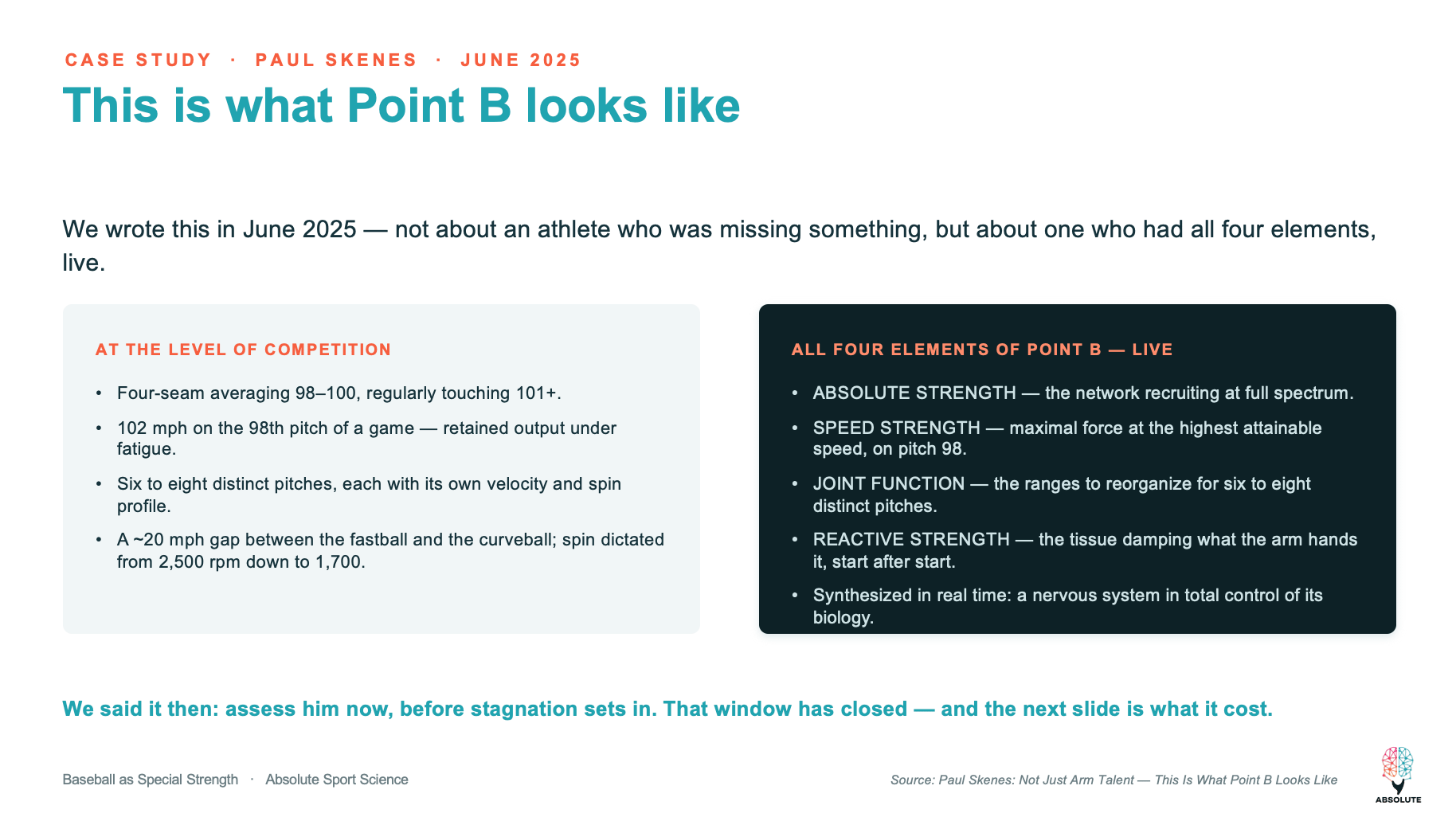
June 2025—this is what Point B looks like: four-seam averaging 98 to 100, 102 on the ninety-eighth pitch of a game, six to eight distinct pitches, a twenty-mile-per-hour gap between the fastball and the curveball. All four elements of Point B expressing live, a nervous system in total control of its biology. We wrote that piece over a year ago, and the line at the bottom of it was: assess him now, before stagnation sets in.
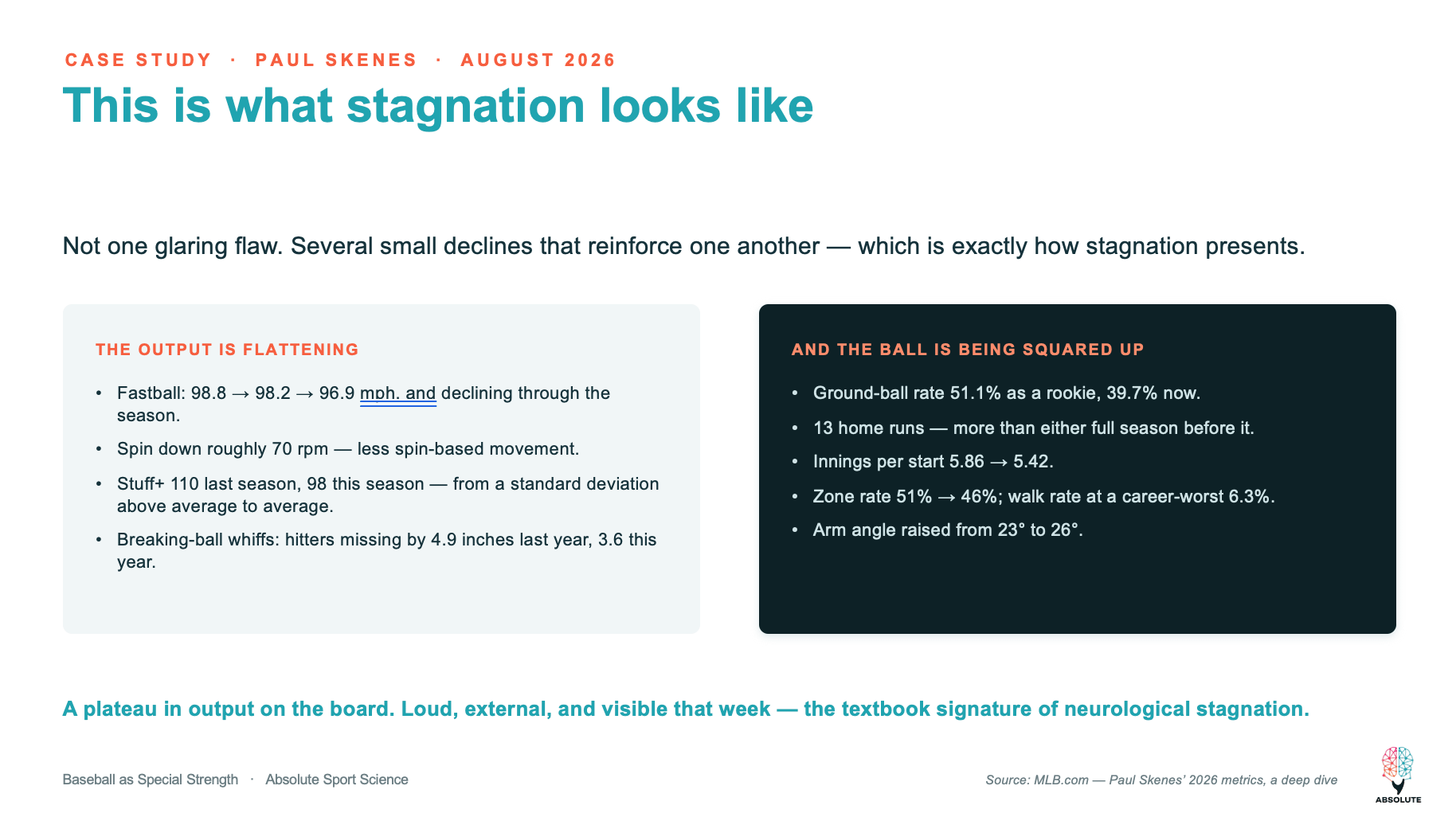
Then August 2026—this is what stagnation looks like. Velocity trending down across the season. Ground-ball rate 51% as a rookie, under 40% now. Innings per start down. Thirteen home runs, more than either full season before it. Not one glaring failure. Several small declines reinforcing one another, which is precisely how stagnation presents.
I was at the front of the room presenting it, and I could see him go on his phone. Not scrolling. Working. Pulling the objective evidence and checking my slide against it in real time.
We broke. He came straight up.
This part is incorrect. This part doesn’t matter.
What he was right about
He came at two bullets.
The spin. I had “spin down roughly 70 rpm—less spin-based movement” on the board. He told me it didn’t matter, and cited Alan Nathan, professor emeritus of physics at Illinois and the person most responsible for what baseball actually understands about the flight of a ball.
He was right, and here is why. Raw spin doesn’t move a baseball. Only the component of spin perpendicular to the ball’s direction of travel—the transverse or active component—generates the Magnus force that produces movement. The component running parallel to the direction of travel, gyro spin, spins the ball like a bullet and contributes nothing. A pitcher can lose spin and lose no movement whatsoever, or hold spin and lose all of it, depending entirely on what the axis did. The number on its own has no meaning.
And spin scales with velocity. If the fastball comes down two miles per hour, spin comes down with it and the ratio is unchanged. Seventy rpm off a fastball in that range, tracking a velocity decline, is not a finding. It is the same pitch, thrown slower.
Then the measurement itself. Nathan has been explicit that there is enough noise in the inferred spin values that you can’t attach much significance to a single pitch. Seventy rpm sits inside the error bars.
The standard deviation. I had Stuff+ at 110 last season and 98 this season, described as a fall from a standard deviation above average to average. He doubted the standard deviation claim. He was right to. Stuff+ is a model output scaled to a mean of 100—whether a twelve-point drop is one standard deviation depends on the population and the sample, and the number carries its own error before it carries any meaning. I had stated a modeled estimate as though it were a measurement.
So: two bullets off the board.
And nothing happened to the case. Velocity down. Ground-ball rate collapsed. Innings per start down. Home runs up, past both prior full seasons. Zone rate down, walk rate at a career worst. Those are outputs of the organism, not artifacts of the instrument, and they still say the same thing they said before he walked up.
He didn’t correct the model. He cleaned the data the model was reading. He made it harder to argue with.
And the model he left standing is the one on that earlier slide: accommodation first, stagnation after. Hold that order. It is the whole argument.
Because the model was never the spin number. The model is inside-out special strength—the claim that baseball is a special strength expressed by an internal state, that the internal state is four elements (Point B), and that when the output at the Level of Competition flattens the way Skenes’ has, you can name which internal state produced it. That is what lets us stand in front of a room and say this is biological accommodation in conjugation with neurological stagnation, and mean something operational by it rather than something rhetorical.
He didn’t touch that. He couldn’t have—it isn’t measured by anything on his side of the wall. What he did was strip two numbers out of the evidence that were describing a tracking device rather than a pitcher, and hand the argument back to us with less to attack.
Which is when it registered what was actually happening in that room. If you want to program treatment, training and practice for baseball as one strategy, you have to understand baseball as a special strength—and to do that you need both halves: a measurement layer honest enough to say which numbers are real, and an internal model capable of saying what the real ones mean. We had spent two days teaching the second half to a room that included a man who does the first for a living, and the two halves fit.
We weren’t defending a framework. We were building something with someone.
This is the part of the Soviet system that never got exported. America imported the manuals. What it never imported was the room—physiologists and biomechanists and physicians and coaches on the same payroll, pointed at the same athlete, each one in a position to check the others’ work. Riordan’s whole book is a description of that arrangement. Louie was buying the outputs of it secondhand, through translators, forty years late.
The arrangement was never the secret. It was just expensive, and nobody here was willing to pay for it. Which is the part we want to be precise about, because we were not there by accident. We were hired. Somebody wrote a budget line for two days of programming education at a developmental academy, and that budget line is what put a sport scientist with programming strategists and a room full of coaches in front of the same pitcher’s data at the same time.
The Soviets needed a state to build that room. It now costs a seminar. That is the whole finding.
He wasn’t arguing with the framework. He was auditing Point A.
Here is what made this collaboration worth writing about.
Go read Have We Been Assessing Hitters Backwards?—his (Jack Cecil) 2020 piece at Pitcher List, built on multiple regression against per-pitch plate discipline data to produce expected walk and strikeout rates. The argument is that hitting analysis has always lagged behind pitching analysis for a structural reason: a pitcher decides what to throw, where, and how—that’s an input. The hitter reacts to all of it—that’s an output. And when you evaluate an output, you are evaluating something that could have been produced four or five different ways. A 22% strikeout rate could be three called strikes, three whiffs, or a ten-pitch battle lost to an umpire’s zone. The number is identical. The athlete is not.
So he goes underneath it. He decomposes the outcome into the per-pitch decisions that generated it, and only then does he tell you what he thinks a hitter actually is.
That is our discipline in a different currency.
A performance drop is not something we ignore—it is Point A. The Level of Competition is the ultimate feedback loop, the place where the internal state finally declares itself in public and generates data we cannot generate any other way. A complaint, a symptom, a velocity decline, a bat speed that fell off in August: all of it is Point A, and all of it is why we assess at all.
What it is not is a programming instruction. Those are outputs, and any given output can be produced by more than one internal state. A hamstring that won’t optimally output could be a hamstring, or a hip, or a neural net that has never been trained, and the presentation reads identically from the outside. The output tells you that something is true. It does not tell you what. Point A exists to take the output apart until you know which internal state produced it—and only then are you permitted to program.
Which is why the quality of the data going into Point A determines the quality of everything downstream of it. Bad inputs don’t produce a bad answer. They produce a confident one.
And the internal states we are decomposing toward are not infinite. There are two failure modes available to a trained athlete, they arrive in a fixed sequence, and almost everyone in this field has the sequence backwards. That is the slide.
He found two numbers in our Point A that were properties of the tracking apparatus rather than properties of the athlete. That is precisely the error he spends his career finding in hitters. Same move, different domain.
The discipline is identical. The refusal is identical. I will not assess this thing on a number I cannot take apart.
Five tools, four elements
He had already done something else for us, earlier in the course, that mattered more than the correction. He gave us the five tools.
This is a man who has ranked an entire farm system prospect by prospect, and who has worked inside the Angels, the Athletics, Baseball Info Solutions and TrackMan. When he tells you what the game is actually buying, you write it down.
Hit for contact, hit for power, run, field, throw. The scouting language—and it landed instantly, because it is the external target our internal model has to resolve into. We do not come from baseball. We knew we didn’t know what baseball actually wants from a body, and a real strength of Absolute is that we know what we do not know, specifically and without embarrassment. What we do know—better than anyone working today—is programming and conjugate.
So he handed us the currency of the Level of Competition, and we handed him the currency of the Level of Adaptation.
Five tools are how the game prices an athlete. Four elements are how the athlete is built. The scouts defined baseball’s Point B decades before anyone had a force plate, and they defined it well—they just defined it externally, in terms of what comes out. Absolute strength, speed-strength, joint function and reactive strength are the same target described from the inside, in terms of what has to exist for any of those five to be expressed at all.
Inside-out special strength is exactly the translation between those two vocabularies. It is not a competing model. It is the layer underneath the one baseball already has.
Why baseball is on the edge
This is the thing I flew home with.
Baseball has built the most sophisticated Level of Competition measurement apparatus in the history of sport. Every pitch decomposed. Spin axis, active spin ratio, per-pitch swing decisions, bat speed, arm angle to the degree. Physicists publishing openly on the mechanics of the ball. An entire public research culture layered on top of a private one. Nothing else in professional sport is close.
And at the Level of Adaptation, it has almost nothing.
Jack can tell you, to the decimal and with error bars, that Skenes’ output is flattening. He can tell you which parts of that flattening are real and which are instrument noise, and he will do it standing at the front of a classroom to a guy who flew in to teach. What he cannot tell you—what nobody in that building can currently tell you—is why. Whether the neural network has stagnated. Whether the connective tissue architecture has failed to keep pace with a nervous system that scaled faster than the tissue could follow. Whether this is a top-down problem or a bottom-up one.
That is not a criticism of him. It is not his layer. Nobody has been assigned that layer.
The measurement apparatus at the Level of Competition is world class and the model of the athlete at the Level of Adaptation is subjective opinion. That gap is the entire reason both of us were standing in that room in the Dominican Republic. It is also, I’d argue, the reason baseball currently leads professional sport in the injuries that come from exactly this asymmetry— bottom-up reactive strength deficits—a game full of enormous neural networks and no institutional model of the tissue underneath them.
What closes it
Inside-out special strength is that layer. Not a competing measurement—a translation.
The five tools are the outside. They describe what the game buys. The four elements are the inside. They describe what has to exist for any of the five to be expressed, and—this is the part that matters—they are trainable and treatable, which the five tools are not. Nobody can program hit for power. You can program the absolute strength, speed-strength, joint function and reactive strength that make hitting for power available to a body, and then let the tool emerge.
Which is the answer to the question Jack couldn’t reach from his side of the data. He can establish, with error bars, that the output is flattening. The inside-out model asks the next question in a form that has an action attached to it: which of the four elements moved, in which direction, and is this a neurological constraint or a biological one? Those two answers produce completely different Mondays. One says compress the network. The other says the network is fine and the architecture underneath it is failing to transmit what the network is producing.
That fork—which of the two failure states you are actually looking at, and which one came first—is the slide I keep pointing at.
And that translation is exactly what happened in the room, in real time, in both directions.
He took two numbers out of our Point A that were describing his instrument rather than our athlete. We gave him a decomposition of the remaining numbers that his framework has no way to generate—not how much Skenes has declined, but what internal state produces a decline shaped like that one. Neither of us could have done the other’s half. Both halves were required, and it took about fifteen minutes on a break.
That is not a metaphor for how the two layers close. That is the two layers closing.
Baseball is one layer away from high performance. It has the external half already built.
Neither lens closes the loop
He is in the Dominican Republic looking for the next billion-dollar talent. We are looking at what it will take to keep that talent intact once he finds it.
Same athlete. Two Point A’s. His is measured at the Level of Competition and it is enormously more precise than ours. Ours is measured at the Level of Adaptation and it is the only one that tells you what to do on Monday.
I spent a decade hearing about sport scientists from the man who's responsible for bringing Soviet training methods to the West in a chalk-covered room in Columbus, Ohio who was buying Soviet manuals to get at what they knew. It took until this August to sit across from one—and to find out that the first thing he’d do is take two of my bullets off the board.
That’s the collaboration. That’s what it’s supposed to feel like when the loop closes.
Further reading
James Riordan, Sport in Soviet Society: Development of Sport and Physical Education in Russia and the USSR—Cambridge University Press, 1977.
Jack Cecil, Have We Been Assessing Hitters Backwards?—Pitcher List. The input/output distinction that runs underneath everything above.
Jack Cecil, Oakland Athletics 2021 Preseason Top 50 Prospects—Pitcher List. What evaluation looks like at scale.
Alan Nathan, The Physics of Baseball—University of Illinois. The active-spin work behind the correction.
Absolute Sport Science, Paul Skenes: Not Just Arm Talent—This Is What Point B Looks Like (June 2025).
The slide
Everything above is the story. This is the bit of programming information of it worth keeping.
This is the slide put up on day two, before Skenes—the one the entire course is organized around, and the one I’ve been pointing back at throughout. It is our account of the two failure states available to a trained athlete, and the order in which they arrive.
