


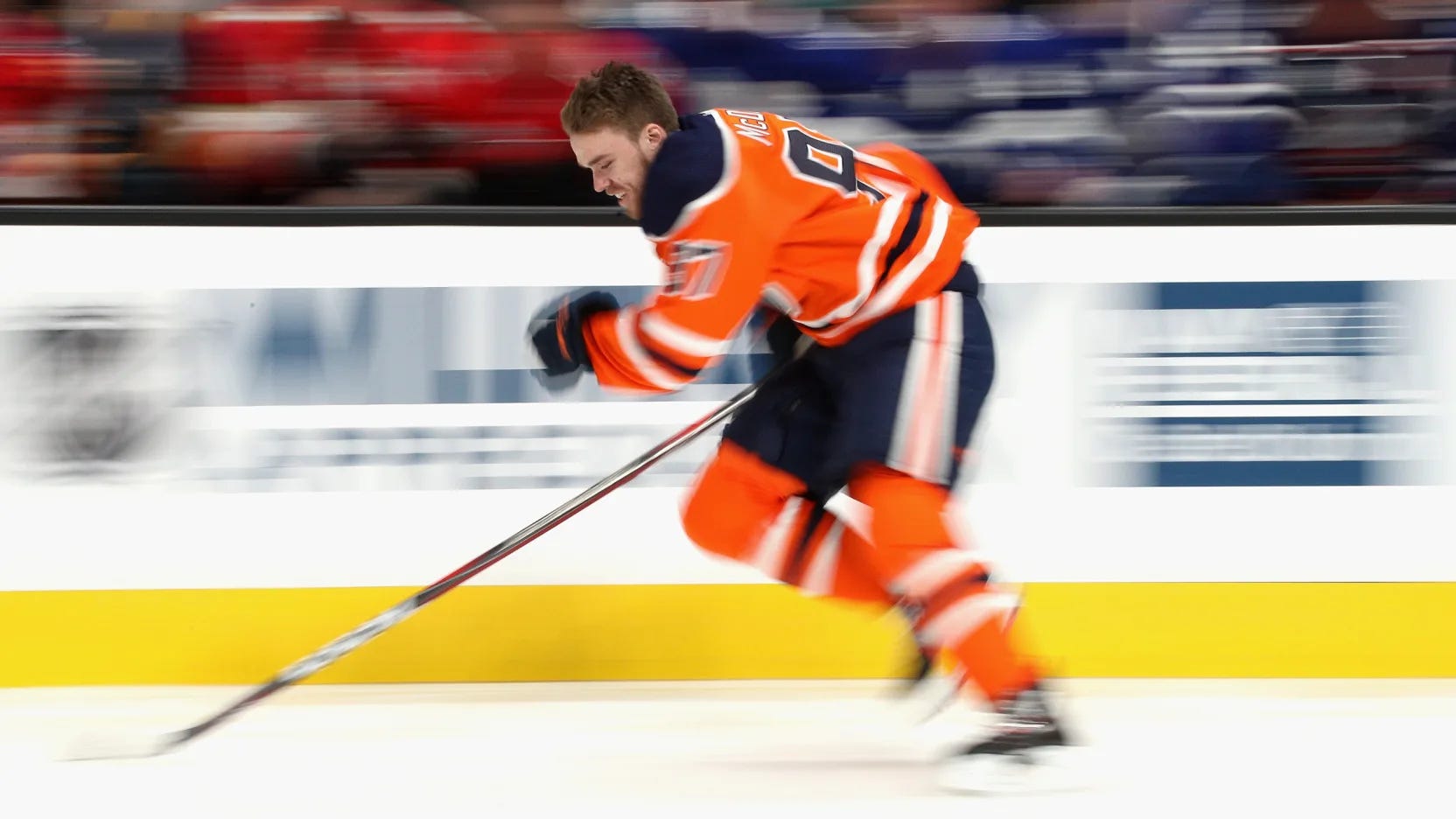
Hockey players move at speeds they could never reach on land. The fastest burst ever tracked by NHL EDGE is 24.94 mph. No skater runs that fast on a field. The ice enables them to glide, so every stride, cut, stop, change of direction and collision happens at a speed the legs could never produce on their own.
That environment makes hockey the perfect Level of Competition to study reactive strength. It is reactive strength at supra-physiological speeds: the tissue has to absorb and transmit force faster than the body could ever ask of it on dry land.
So what do we program off the ice? Not more speed. The game already supplies the speed. We program the opposite—because we view skating as a special strength, from the inside-out.1
Slow Reactive Strength: A Special Strength
Reactive strength is a conjugation, a syncing of the neurology with the biology that enables the optimal transmission of force. Most who program for this special strength only think of it from the top-down—neurologically so they program fast: jumps, bounds, plyos. But reactive strength has a slow end, where the neural network of absolute strength controls the external resistance slowly enough that the connective tissue feels the strain eccentrically at tissue length and tension concentrically.
That is slow reactive strength. It is a special strength in its own right, and it is the one that stimulates the development of the connective tissue from the bottom up.
From High-Low to Fast-Slow
Canadian Olympic sprinter and sprint coach Charlie Francis most noteworthy for being the strength coach + programmer of sprinter Ben Johnson gave us the high-low model. High days stimulate the nervous system: sprints, jumps, maximal lifts. Low days stay low: tempo work and recovery. What he avoided with his athletes was the middle, the medium day that builds fatigue without building the athlete. Credit to Charlie. We carry the logic forward.
For reactive strength, high-low becomes fast-slow:
Fast: The Level of Competition. For a hockey player, that is the fastest reactive strength in sport, and it happens multiple times every shift of every game.
Slow: The weight room. Slow-reactive strength, where the tissue gets the stimulus of strain and tension the game simply cannot provide.
The middle: Avoid it.
In season, the hockey player already has fast covered. The nodes within the neural network are already stimulated and primed. If we add more fast off the ice, the neurology scales and the tissue responsible for force transmission—strength expression, gets left behind. That is how Reactive Strength Deficits develop over the course of a season.
So in season, the hockey athlete programming should stimulate slow reactive strength off the ice. That is what lets the connective tissue keep developing from the bottom up while the game provides fast.
