


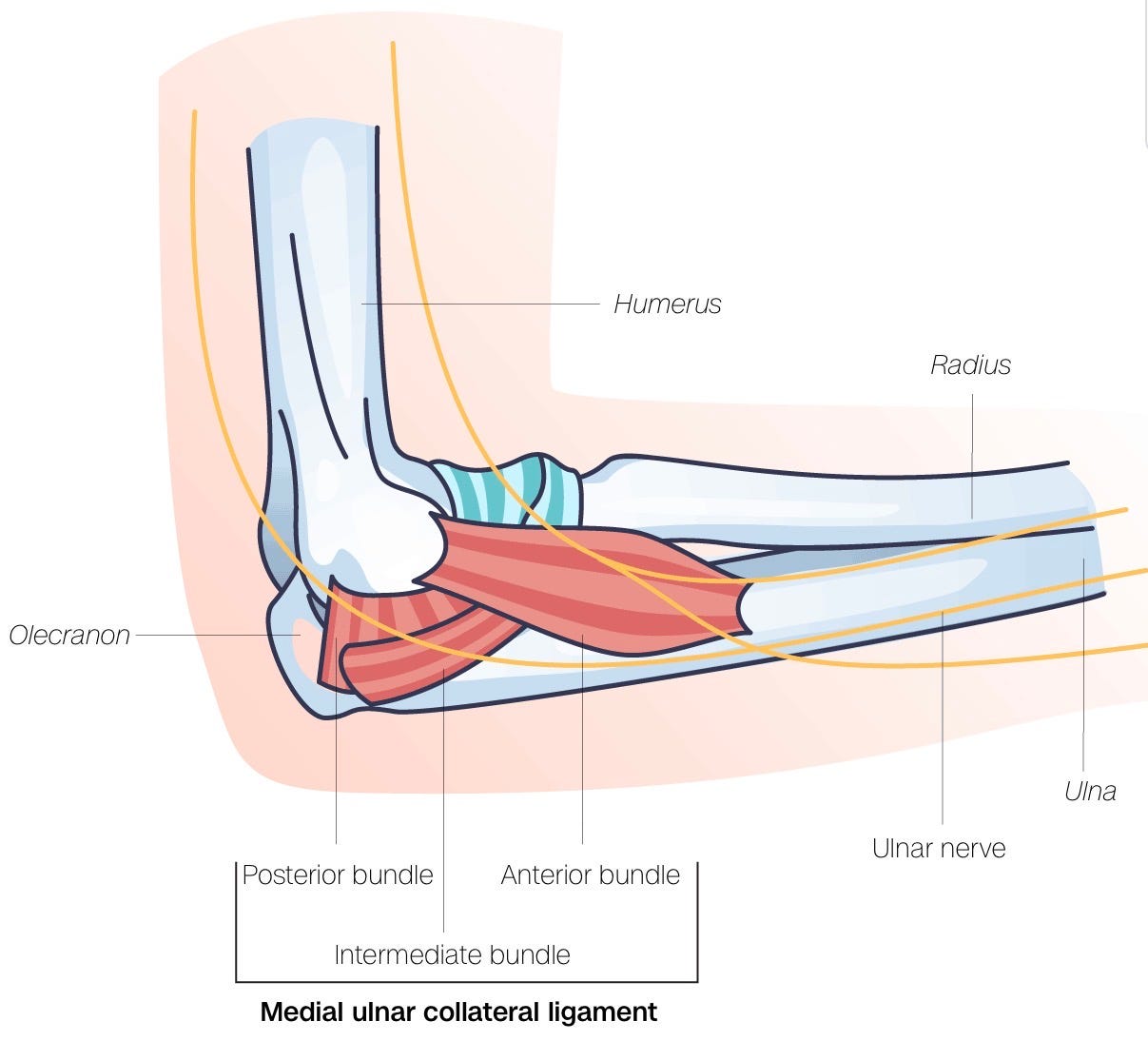
The series featured two starting pitchers, Shohei Ohtani for the Dodgers and Shane Bieber for the Blue Jays who returned to pitching at different times this season after undergoing UCL reconstruction. In Ohtani’s case, this was his second elbow reconstruction in his career so far (he’s 31), and he hadn’t pitched in a Major League game since 2023. Bieber returned late in the season after undergoing his reconstruction in early 2024.
At Absolute, we published a series of articles on the UCL during the 2023/24 season when it seemed the discussion surrounding elbow injuries in throwers had hit a peak. It seems as though the 2025/26 season reinvigorated the discussion concerning the UCL injury, its prevalence within not only MLB but all the way down into youth baseball.


The Status of Youth Pitching
Dr Chris Ahmad, team orthopedic surgeon for the New York Yankees, who repairs hundreds of elite throwing elbows every year, recently shared an article from CNN discussing the current state of baseball training, specifically of pitchers, specifically those in their younger years.
This is where the discussion on UCL injuries and subsequent reconstructions changes and becomes a very serious issue surrounding athlete development. It is understandable, although still devastating for a Major League pitcher to tear the ligament and undergo reconstruction. It sets them back in their career projection as the time to return to pitching post surgery is 12-24 months with a repair of the UCL being just slightly quicker (6-10 months). For the most part, these athletes return to a similar level of throwing after returning to competition.
When it comes to younger athletes who tear their UCL this has potential life changing consequences. The talk of career projection shouldn’t come into the discussion, although it does for so many of them on the hunt for MLB draft status and exposure to Division 1 programs. This is part of the reason why, as alluded to in the CNN article that Dr. Ahmad performs the majority of his elbow surgeries on high school and even middle school pitchers. This is extremely sad, and highlights a significant asymmetry between professionalizing these young athletes and actually developing them to reach the next level of baseball. This asymmetry is continually compounded leaving us with the current rates of injury.
The Absolute View
We have discussed repeatedly at Absolute about the asymmetry that exists in training between the nervous system and the biological tissues that ultimately leads to what we refer to as Reactive Strength injuries, those that exist within tendons, muscle, connective tissue and ligaments.

In our view, the top down component of strength (and speed) which is a neurological output far exceeds the bottom up component of stiffness that transmits that strength (as force based energy). At its core, and regardless of athlete age or level, the UCL tear in a throwing athlete is a Reactive Strength injury that manifests from an excessive force being borne by the elbow and its restraining tissues and the actual load bearing or stress stiffening capacity of those restraining tissues. When one exceeds the other, breakdown and subsequent injury is the result.
We have stressed in our discussions on these types of injuries that it is the perpetual scaling of the nervous system through training that allows for the continual addition of nodes and connections within the athletes neural network that enables the network to create tremendous outputs and displays of strength. While on the downside there is an oversight in training as to the simultaneous scaling of biological tissue behaviours that must be linked with the neurological outputs of the network. A constantly scaled nervous system is akin to gambling in Vegas. It’s fun while it lasts but as we may or may not know from experience the house always wins.
Athlete Development Ecologically
Understanding that there exists a chasm in training for high performance between the continual scaling of the neural network and the necessary acquisition of biological tissue behaviours allows for a more ecological view of the current UCL issue in young athletes. It is the repeated training to acquire “velocity” an output of the neural network which comes at a supreme cost to the system overall. Namely that there is zero training that exists within the biological niche and hence the system crashes.
It could be argued that the over professionalization of youth sports, training very specifically the majority of the time, which starts at a very early age, takes away a large biological base for these athletes that becomes evident later on during their middle or high school years. The loading of tissues and joint structures during general play that would occur during jumping, landing, rolling, climbing and hanging provides this base and is very often being missed in these young athletes.
Neurological Dominance
The nervous systems of young athletes are extremely plastic and easily responsive and adaptive to new inputs particularly those that are repeated over time. These are neural networks that are ripe with neurons that are primed to make as many connections as possible and to do so rapidly. This is the reason why we see the young pitcher improve so much within a relatively short time frame!
Within the training that is specific for pitching at the high school level such as plyoballs, pulldowns and throwing with a radar gun, it requires maximal intent on the part of the athlete which constrains the top down component to output at high effort levels repeatedly. When the output of velocity is the priority it creates a positive feedback loop for the coach to continue doing the training that is working, ultimately creating an asymmetry between ecologies.
Biological Submission
On the other side of the asymmetry lies the biological continuum. Often severely neglected at any age of pitcher but more so in the younger ones. Mainly this stems from a variety of potential reasons, likely the early specialization into more advanced forms of throwing with high intent plays significant role, but the missing out of youth athletes of being athletic and building a good foundation of athletic skills also has a large role.
In addition, although ironic, there is a feeling amongst some coaches and parents that building a foundation of strength through progressive resistance training using overload is too risky and will lead to injury as often this is associated with “weight lifting” and deemed to be non-essential in the creation of an athletic foundation.
How to Better Link the Neural Network and the Biological Continuum
If we thought about all the above more ecologically and constrained to the youth baseball UCL Reactive Strength Problem, we would allow kids to be kids!
Repeated efforts of being kids compounded by early on and through the middle school years creating a foundation of athleticism through hanging, climbing, jumping, balance and running are key foundations that stress the outer biological system and links it to the neurological network. This is a time where extreme levels of plasticity dominate.
As they progress into high school years a conjugate strategy that involves training that exists in both ecosystems is imperative. This includes reducing throwing volume when necessary (off-season) and providing the opportunity to progressively overload the system with good fundamental training appropriate for the age and training level of the athlete. Again, plasticity reigns and linkages between the capacities of Biological Point B and Neurological Point B can be made.
“We are too fascinated by the events they [systems] generate. We pay too little attention to their history. And we are insufficiently skilled at seeing in their history clues to the structure from which behavior and events flow.” - Donella Meadows
This article reminded me of Donella Meadows' work - specifically how we get trapped focusing on events (velocity numbers, injuries) and trends (seasonal improvements) while missing the underlying system structure that generates them.