


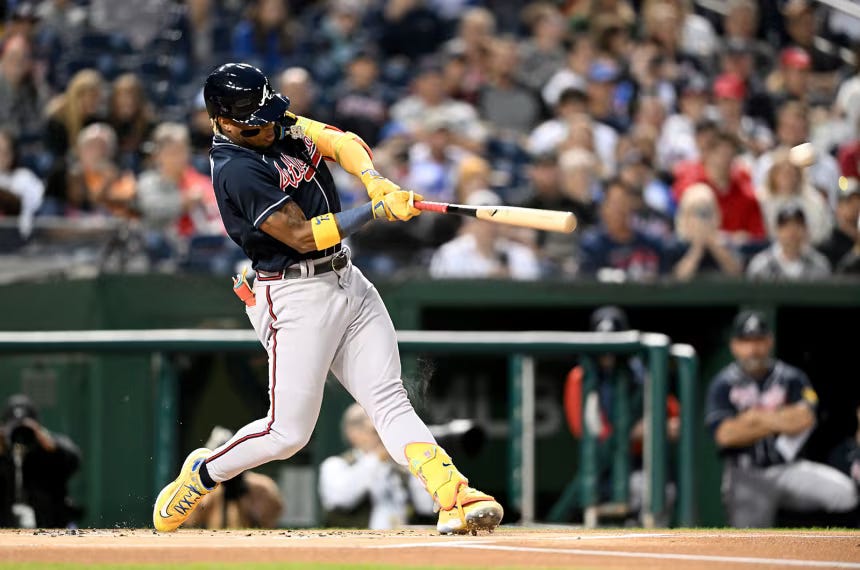
In our last substack on Ronald Acuña Jr., we highlighted his injury timeline—two ACL reconstructions, followed by two hamstring strains in the same 2026 season—both reactive strength injuries, on baseball specific efforts (base running + sprinting after a fly ball) at the Level of Competition. It is our belief that this is case study on link between the ACL and hamstrings—specifically not a strength deficit per se but an information flow feedback deficit.
Since we do not work with him directly, we are assuming that he can pass basic strength testing of the hamstrings—whatever the Braves are utilizing. Most likely they have force plate testing of the hamstrings that is showing that the magnitude of force output is there and is symmetrical between limbs. With him being at Neurological Point B—that is possessing a large neural network of absolute strength, we assume that he passed that in flying colors, but what that type of testing/assessment does not show is whether the loop between the ACL and the hamstrings—the one that lets the neurological network of absolute strength react to chaotic loading on the baseball field—has been reestablished and is intact.
If that feedback loop is what’s missing—or even lagging, general hamstring strengthening won’t rebuild it. It needs a specific input that trains the ACL and the hamstrings in conjugation, in the same rep, under the same reactive strength loading that injured his hamstrings in the first place. That’s exercise 3 in Absolute’s Reverse Hyper Program.
The Exercise that Reestablishes the ACL-Hamstrings Feedback Loop
Exercise 3 is three dynamic effort repetitions of an open chain hamstring curl on the reverse hyper, followed by a pendulum catch + damping.
The athlete uses their neural network of absolute strength to generate dynamic efforts with their hamstrings to curl into knee flexion. As the pendulum gains energy from the hamstrings curls and swings faster and faster, on the eccentric phase of is repetition, the training intent switches to use the hamstrings to catch the pendulum and damp it.
That means the hamstrings have to eccentrically absorb and stress-stiffen against real, moving energy, not static load/resistance. The knee is doing genuine deceleration work through that catch, which means the ACL isn’t a passive bystander in this exercise—it’s an active participant in stabilizing the joint while the hamstrings + ACL and other connective tissue structures of the knee joint like the capsule, do the work of killing the pendulum’s momentum.
That’s the loop, trained directly. The hamstrings can’t stress-stiffen effectively without accurate real-time information from the joint about where it is and how much tension it’s under. And the joint’s signal is only useful if the hamstrings can act on it fast enough to catch a moving load. Exercise 3 constrains the hamstrings and ACL to conjugate together and as result the ACL-hamstrings feedback loop gets stimulated and reestablished.
Conjugating Joint Function with Reactive Strength to Reestablish the ACL-Hamstrings Information Feedback Loop
Pre-exercise 3, knee joint CARs. This stimulates the articular receptors of the knee before the pendulum work starts, so the joint is already feeding accurate signal into the neural network of absolute strength before the reflexive loop gets asked to output. Post-CARs, exercise 3 locks that signal in—it’s the loop having to operate under real, moving load right after the receptors have been primed.
Two sets is the floor to make sure the loop is actually getting stimulated. And this isn’t a once-a-week input—it’s daily. For Acuña specifically, given where he sits in return-to-play, multiple sessions per day is warranted to get the loop reestablished at the rate his case demands.
If you want the full specifics on exercise 3—how to execute it, the prerequisites to get there (exercises 1 and 2), and what mastery of it actually looks like—get the Absolute Reverse Hyper Program.
The research behind why this specific movement targets the loop, and how it should be programmed into Acuña’s specific case, is available to paid subscribers.
