


Welcome to Installment #04 of The Conjugate Edge. Each month, we publish one essay designed to help programmers in strength and clinical settings step off the linear path and onto our conjugate strategy—one that propagates athletes from Point A→ Point B. This is the programmers go-to source for the most up-to-date thinking on Conjugate—not as a method, not as a system, but as a living programming strategy that treats and trains concurrently in real time. Want to join the conversation? Become a paid subscriber to access comments and our private chat. Want to go deeper? Check out our online course: The Art & Science of Programming.
Lessons Learned at the Edge: Treating at Westside Barbell
Working at Westside Barbell in conjugation with Louie Simmons taught us many things—but one was clear:
when programming at the neurological edge, you need to hedge.
New lifters would enter into his barbell club and next thing you knew they were getting referred for treatment because this or that tissue blew up. We met a lot of lifters this way.
And when that tissue transitioned into biological jelly, it was normally a massive blow up as they aren’t playing with baby weights—this is training. It was maximal loading + multiple forms of accommodating resistance. Chains and bands—both plural.
As a friend told me, when you are training with maximal loads there is no warning—it just goes. You know, like a broomstick breaking. He ruptured his triceps tendon.
An all‑time world record holder blew his ACL bench pressing. As Louie would say, they walk into hard ground straight into quicksand.
The Gear is a Hedge
An old‑time member of the club, Darrol Mayo (rest in peace), would complain to me about these bench shirts—“I don’t get it. Why?”
I met Darrol through Louie. They training partners in the time before geared lifting ( a long time ago) and remained close friends.
He knew I trained raw (no gear) and so did he. Back in his heyday of training, the parents whose kid invented powerlifting gear were not even dating. So he didn’t get it.
As a bodybuilder, I didn’t either. My programming intent was very different and honestly I was too concerned with competing to care at the time.
He would call me at random—always a pleasant surprise—and we would talk on the phone. He had a grandson who was interested in bodybuilding and we would talk about his programming and how it could improve. I knew the phone call wouldn’t end until he would say: “Hey, why you think Louie embraces these shirts?”
Once I started treating there, I quickly understood why the gear. Louie didn’t have a choice if he wanted to program on the edge.
The Art & Science of Palpating for Reactive Strength
The reactive strength injuries there were different. You won’t read about them in your textbook. In school, during our clinical hours, clients weren’t showing up missing hunks of tissue.
We are not talking about your general‑population office worker who had joint dysfunction and compensation for years with all the cascades. We get it, tech neck hurts—but those tissue are still attached to the tendon and tendon to bone.
You had red muscle tissue ripped from the white connective tissue of the tendon—literally. True story: there was a case where the patellar tendon ripped a part of the bone off the tibia tuberosity. You read that correctly. The surgeon in his post‑surgical notes noted that this was a different reactive strength injury, the patella ripped a hunk of bone tissue off.
Dr. Chivers taught me how to palpate tissue in a way that makes it treatable.1 Prior to that I was did not have the right mental constraints to acquire the information I need—the information flow that tells me what my programming options based off of the findings I was acquiring as a therapist.
How I learned was find the bony landmark. Drop into tissue and strum across that tissue with your fingers until you roll into an epimysial boundary, then roll back. That is boundary of the muscle belly.
Now you know where the muscle is, palpate that tissue—within the epimysial boundary constraints.
Okay, this tissue is going east west because I can feel the direction of the striated red muscle tissue. So this tissue is the first tissue distal (south) to the clavicle and it is going east west in the a thick tendon that insert into the arm bone—this is the clavicular head of the pectoralis major (pecs).
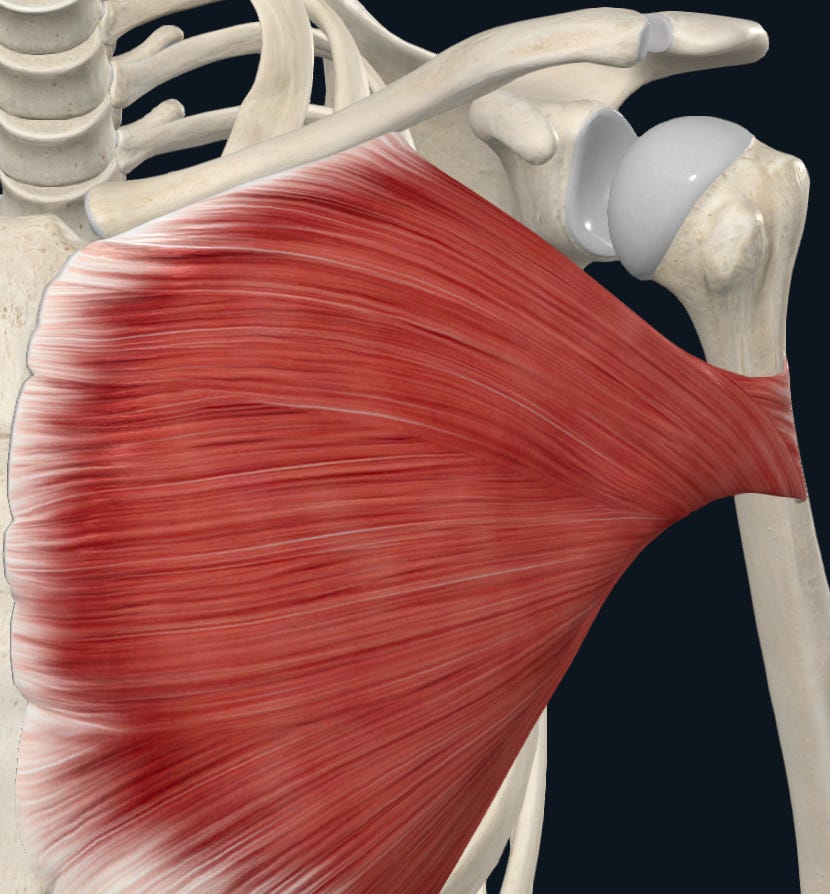
When you move out of those epimysial boundaries, you are now palpating your way to a different muscle belly.
Once on the correct tissue—let’s say the clavicular head of the pecs, you can start to move shoulder joint to see how the tissue behaves, that is organize itself. This organization you will feel as tension, as length scales into the white tissue.
You are feeling the length tension curve. Okay, what does that feel like? Are we on an elevator or escalator?
Palpating like this is as you can see both an art and science—a conjugation. The science gets highlighted when you can in fact feel that tension. As you feeling the length-tension curve of the bottom up element of reactive strength—you know element that no one is really accounting for.
Why? Who knows, maybe they are too heavy in the sciences and not in the art of actually palpating tissue. Thats our bet. But good luck programming reactive strength without that information flow—because you are going to need it.
Palpating at the Edge of the Neurological Paradigm
Now that we know the standards for the palpation. That we are palpating to acquire information flow on the bottom up element of reactive strength. You should know that things change at the edge.
What I didn’t learn was what happens when you get off of the bony landmark and drop way down, like falling off a cliff and landed on bone.
It was like this. Okay we are thinking that there is an issue with the pec? Let me get to clavicle—the bony landmark, done. Okay let me go south and I will be right on the clavicular portion of the pec major. And here is the drop. Okay this is a bigger drop. Finally hit something but this does not feel like striated muscle tissue. Its bony.
The first time, I was too naive and kept going back to the bone and trying to drop into the tissue. You know I thought there was an issue with my palpation. But after multiple iterations of going back to the clavicle and then falling into the sternum I realized the tissue wasn’t there. Fuck.
It’s different when you don’t just feel a reactive strength injury that but when you actually palpate it.
When you actually roll your fingers over the clavicle and hit sternum. Then start to palpate around and start to feel where the tissue mechanically failed. Within the deficit, you can literally feel the fraying—you know where the red tissue ripped from the white tissue. Palpating that, is how you sharpen your palpation skills—something as a therapist you should always be working to improve.
Information flow generated from palpating acute reactive strength injuries is very unique. It gives the you insights that if you haven’t felt it, we can confidently say you just don’t know.
This is the norm when palpating on the edge of the neurological paradigm.
After palpating enough frayings of tissue, I would tell Darrol, things have changed brother—the gear is not an option for the programming game Louie is playing.
Gear as a Programming Hedge
The programming game Louie was playing to win was to set all‑time world records in the sport of powerlifting. Records are plural, not singular.
The taste of victory must have been so sweet after Lou coached him to his 1,000lbs squat that he wanted more. He ended up programming over 140+ all time world records. There is a song that say one thing leads to another and one record lead to another and then next thing you know Lou had himself a stranglehold.
With our inside-out special strength mental model of reactive strength, we understand that the gear is external connective tissue.2 Now the nervous system can scale more. We could keep going with conjugated training effects, but understand Louie was a very intelligent man. He saw that logic and played that game until he put the sport of powerlifting in a stranglehold—and he didn’t stop squeezing.
20/80 Principle as a Programming Hedge
That is why we educate programmers to get the athlete to Biological Point B. Eighty percent of volume is biological programmed with the specific intent to stimulate Point B. We need to keep scaling Bio Point B—at least for the programming game we play here at Absolute.
Darrol trained in a different era. He trained at the start of the sport—it’s not that old. During that era you could program linear and it would set an all-time world record. Think of it like the Stone Age of Training Science—and technically that term was first used in 2020s.3
During Darrol’s time lifters could program linear for the lift and actually set all time world records. If you program like that in 2026 you get neurological stagnation—and we here at Absolute urge you to educate yourself and change with the times. Programming should be Point B centric not, I’m doing progressive overload—whatever that means?
It is hard to separate the muscle from the tendon when the neural network of absolute strength is stagnating. The injuries in the Stone Age where from too much volume. They were overuse reactive strength injuries. Ones where the tissues degraded but didn’t break like the broomstick totally unexpectedly. That comes from a very different neural network of absolute strength—trust us.
Darrol hadn’t seen this shit in his day. He was the kindest man—delivered cancer medication to patients, but word in the gym was Lou met him after he found out Darrol could fight. Being close friends with Louie over decades meant he was a badass, but he wasn’t dumb.
If he had to palpate muscle tissue that was separated tendon—where you could the deficit and the fraying of tissue, he would have said “hey what size you think I am in that gear?”
We Are Not in the Stone Age of Programing
Back in the Stone Age of programming, they just didn’t understand how to scale up the nervous system. The bar (all-time world records) in the sport of powerlifting was so low that linear periodization briefly allowed lifters to set all time world records.
Louie had yet to perfect neurological scaling of absolute strength using the Soviet methods. But desperate men do what desperate men do, and once Louie—a crane operator—read from Dr. Zatsiorsky that it was the nervous system he had to scale, the programming would change—rapidly.
The Biological Law of Specificity would reward Lou and his barbell club. Once he got the sequence conjugated, that collision would initiate the neurological Big Bang. We not only saw the Big Bang, we palpated it.
What would come next is the biological bubble. To hedge against that bubble Lou used gear. His programming was so far ahead of the rest of the world that it is crazy to consider what he was doing and at the time he was doing it. He was the edge of programming for absolute strength.
Hedge Your Programming
You should learn how to hedge your programming with the Art & Science of Programming. It is the only place where you will learn how to program internal and external treatment + training work to develop joint function in conjugation with reactive strength, speed strength and absolute strength.

