


Welcome to Installment #13 of The Conjugate Edge. Each month, we publish one essay designed to help programmers in strength and clinical settings step off the linear path and onto our conjugate strategy—one that propagates athletes from Point A → Point B. This is the programmer’s go-to source for the most up-to-date thinking on Conjugate—not as a method, not as a system, but as a living programming strategy that treats and trains concurrently in real time. Want to join the conversation? Become a paid subscriber to access comments and our private chat. Want to go deeper? Check out our online course: The Art & Science of Programming.
Taking conjugate to the edge we find Programming Science
In Installment #01, we described the edge of chaos: the zone between order and disorder where old structure breaks down just enough for something more complex to emerge. The Conjugate Edge exists to take Conjugate into new realms. When you push something to its edge, some things remain, some things change. The old order, programming filed under training, stops making logical sense. Out of that chaos comes a new order: programming as its own science—and it sits over the top of not just training but also treatment.
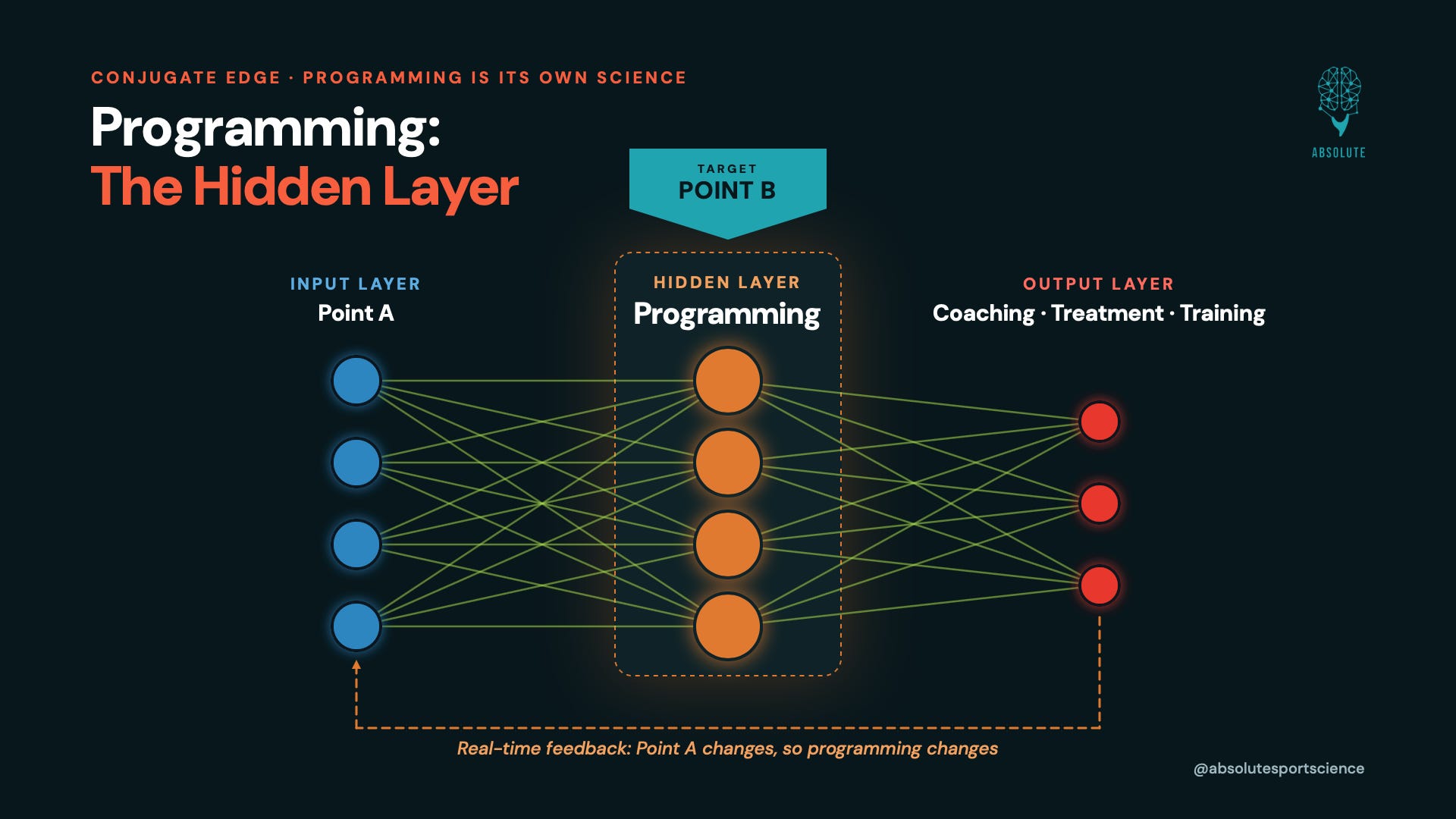
Operationally programming is the hidden layer: the strategy that not only shapes treatment and training—but conjugates them so that cumulative multifaceted effects emerge in a way that propagates the athlete or client to Point B. It is only through leveraging programming that Point B as defined by a future physical state and a destination is attained.
On this point, we respectfully part ways with Dr. Zatsiorsky. Science and Practice of Strength Training treats program design as a part of Training Science.1 We disagree.
Yuri Verkhoshansky, a Soviet scientist and a coach, was the first to give programming its own name and definition in his manual.2 Why? He could see the difference because he did both jobs. The Soviets loved to conjugate: coach + scientist in one person. As a jumps coach, he created training methods, including the shock method. As a scientist, he analyzed what those methods did to the same athletes over months and years. Observing both, he found that the same training didn’t produce the same result. Its effect depended on the athlete’s current state, what we at Absolute call Point A,3 and on the order (sequence) of the training. His own shock method shows it: depth jumps after a block of heavy strength work don’t produce what the same depth jumps produce without it. So the decisions about the training, what to do and in what order, mattered as much as the training itself. That’s why he gave programming its own name. We’re building on that distinction.
That distinction—that reality—means programming isn’t a component of training. It’s a science of its own, and it lets you be an artist with treatment and training: solving the deficits that used to end careers, and conjugating the work so special strengths emerge at the Level of Competition in ways that would shock the Soviets who first pushed training to the edge.
Here’s the definition we’re putting forward:
Programming Science (Absolute Sport Science, 2026): The study and practice of organizing treatment and training, conjugated as one strategy and adjusted by feedback, to propagate each athlete from their unique Point A to Point B, in real time and over time, so they are in a optimal physical state to learn and express skill at the Level of Competition.
Here is what each bit of information means:
Organizing treatment and training. Selecting what work gets done (treatment + training inputs), in what sequence (order) and how much.
Conjugated as one strategy. Treatment and training aren’t two plans running side by side, even when two people deliver them. They’re joined—conjugated into one strategy, so each shapes what the other can do and elicits multifaceted effects.
Adjusted by feedback. The athlete’s response to the work and their physical current physical state (Point A) relative to Point B dictates the strategy.
Each athlete’s unique Point A. Point A is where the athlete is today. No two athletes are in the same place, and the same athlete is never in the same place twice. Point A is dynamic.
To Point B. Every decision aims at one defined destination—to attain and retain optimal levels of the four fundamental capacities of Point B: joint function, reactive strength, absolute strength and speed strength.
In real time and over time. Decisions are made leveraging real time feedback and analyzed over weeks, months and years.
At the level of competition. The athlete is still practicing and playing their sport, and playing to win. That’s the Level of Competition, where the sport coach teaches skill. Strength coaches and therapists don’t work there, but Point B is the optimal state that lets the athlete learn and express that skill. The strategy aims for what’s built in treatment and training to transfer there.
This definition, and new science draws two critical distinctions.
