


Tissue-Specific Mechanism of Injury
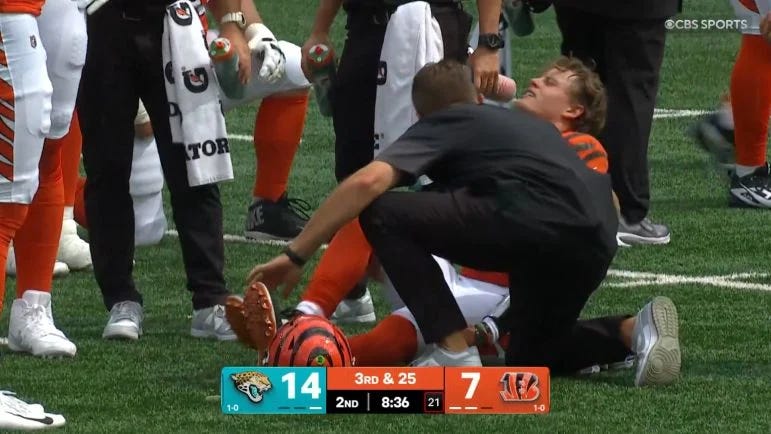
On the film, you’ll see Joe Burrow’s right lower extremity get locked into position by the defender (#91), eliminating available ankle joint space—meaning he cannot move through his ankle any further.
When Burrow tries to escape to avoid the sack, his body falls forward. With no more motion available at the ankle, all the range-of-motion demand shifts down into the big toe—real time biological bottleneck.
The big toe (first MTP joint) is then forced into excessive dorsiflexion. The tissue on the bottom opening side of the joint (plantar surface of the big toe) is taken to length under the conugated load of Burrow’s bodyweight at speed.
That’s an excessive force to transmit for that tissue, and the bottom-up element of our definition of reactive strength (connective tissue)—yields.
That’s turf toe. From our perspective, that of a strength programer, this is a reactive strength injury.
Same Injury Pattern, Different Constraints
We have seen similar connective tissue failures in the NBA Playoffs (Achilles tendon ruptures). But those were relative reactive strength injuries. Burrow’s injury is different in that there is a violent external force transmission element that occurs within the Level of Competition in the sport of football that is not as present in many other sports. Nevertheless, this is still a reactive strength injury.
